

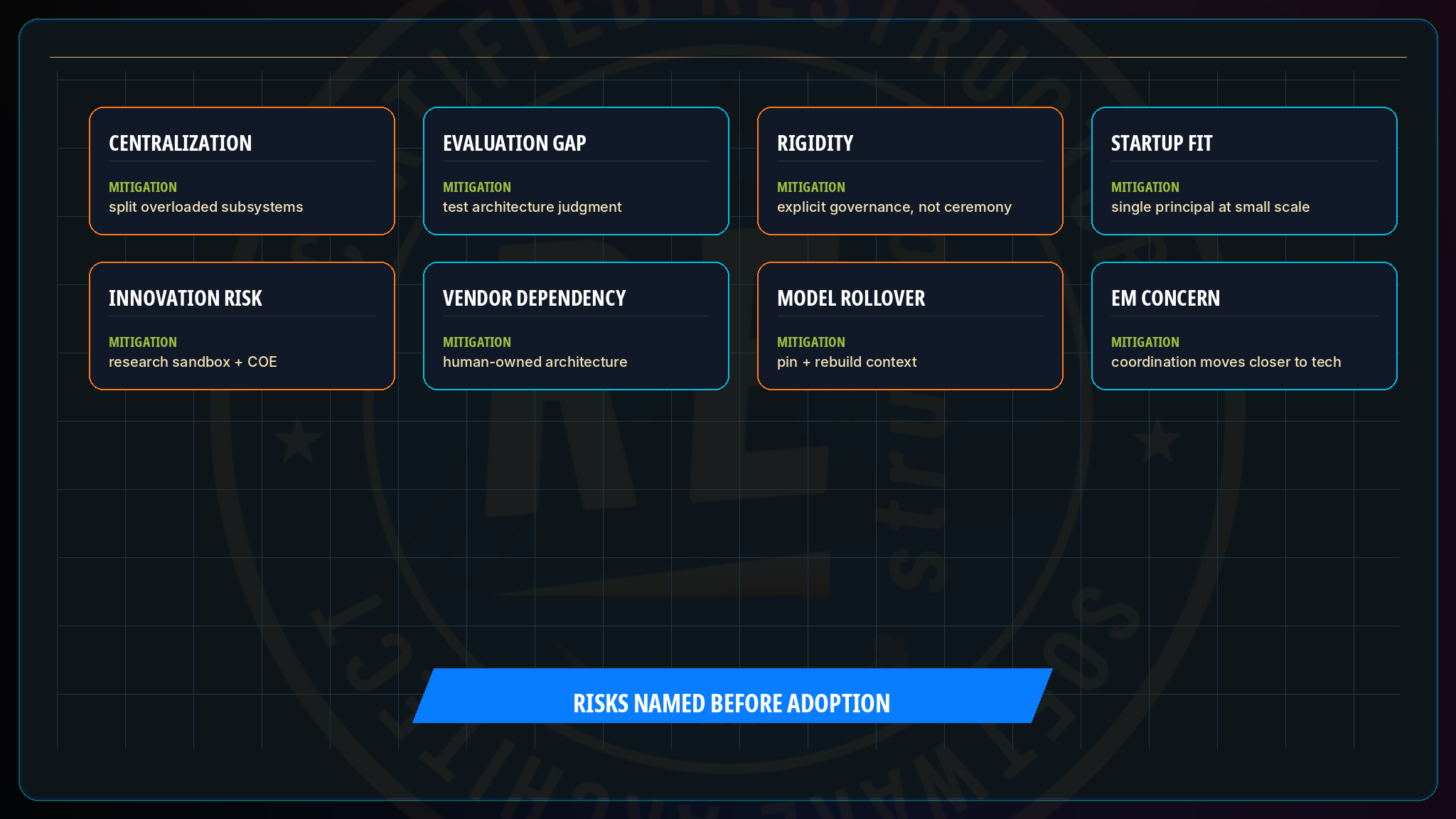
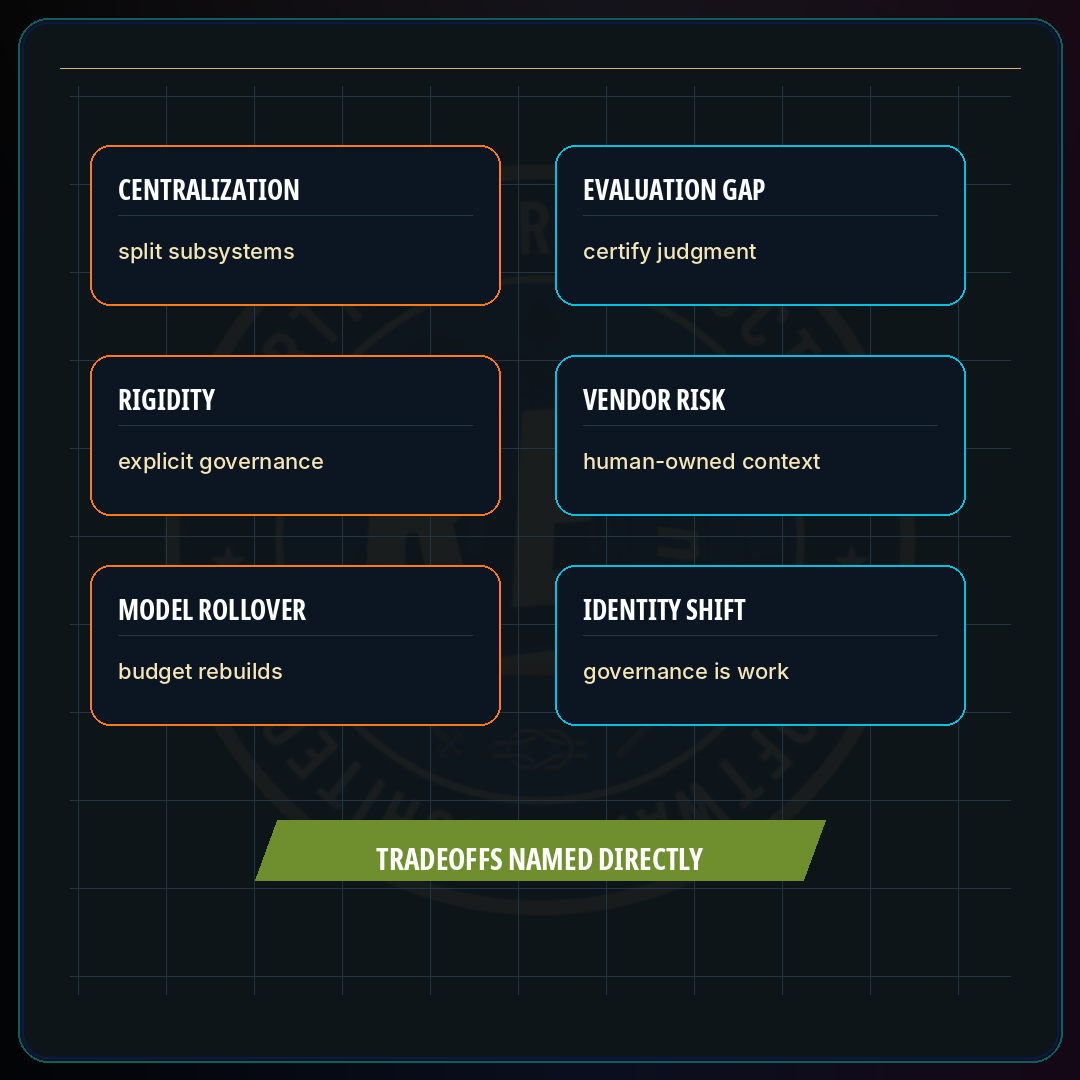
Every organizational model creates tradeoffs. Restruct ™ is no exception. The purpose is not to pretend complexity disappears — it is to reorganize complexity around governed architecture rather than coordination chaos.
Centralization risk. Restruct ™ concentrates AI orchestration authority around the Principal Architect layer, and a natural reading is that this trades safety for speed. The framing is backwards. As Chapter 10 develops, concentration is the throughput strategy, not a tradeoff against it. Distributing orchestration multiplies the PR review burden faster than it multiplies output, and architectural coherence does not survive distributed context. The real risk in the methodology is not that authority is concentrated; it is that an organization fails to decompose its system into enough subsystems and ends up overloading one Principal Architect across a domain that should have been split. That is a structural failure, addressable by carving the subsystem into bounded contexts and standing up additional Architecture Groups. The corrective is always to subdivide governance authority, never to dilute it. A weak Principal Architect concentrates dysfunction, which is a real concern and the reason the evaluation gap discussed below matters so much — but the structural answer to overload is more Architecture Groups, not more orchestrators per group.
Evaluation gap. The industry has no widely accepted equivalent to architectural licensure, the legal bar, or engineering board certification. Modern hiring still optimizes around algorithm memorization, isolated implementation exercises, syntax interviews, and framework trivia — which evaluate implementation fluency, not architectural judgment. Many capable implementation engineers struggle with sequencing, subsystem governance, product reasoning, or large-scale systems thinking. Some exceptional architects perform poorly inside implementation-focused interviews despite stronger leadership capability. Organizations historically required sixty to ninety days of side-by-side work before accurately evaluating systems reasoning, communication, sequencing, and governance.
Restruct ™ proposes formalizing architecture evaluation through the Certified Restructor ™ program, testing the disciplines this methodology depends on — subsystem decomposition, contract definition, sequencing, QA governance, and AI orchestration — rather than implementation fluency. Long term, AI-assisted evaluation may simulate architectural collaboration environments directly, approximating the sixty-to-ninety-day evaluation process. This matters because AI-native organizations have less tolerance for weak architectural leadership than ever before; Principal Architect roles cannot become inflated titles handed out through tenure alone.
Elitism concern. The structure may appear exclusionary because implementation-heavy pathways become less central. But AI-native environments force a confrontation: repetitive implementation labor is rapidly commoditizing, and pretending otherwise does not protect workers long term. Restruct ™ creates new upward pathways through architecture, governance, product reasoning, sequencing, research, and QA governance. Research Fellows and Associate Architects exist specifically because the industry still requires apprenticeship systems, learning loops, and institutional knowledge transfer. The apprenticeship model does not disappear — it evolves.
Rigidity concern. Architecture-heavy governance may reduce experimentation speed or create bureaucracy. That risk exists. But many modern organizations already operate under hidden bureaucracy through sprint rituals, planning ceremonies, fragmented approvals, duplicated implementation, and dependency confusion. Restruct ™ replaces ambiguous coordination bureaucracy with explicit architectural governance. The assumption is that clear subsystem ownership and deterministic contracts accelerate execution more effectively than generalized autonomy operating inside ambiguous boundaries.
Startup applicability. Early-stage startups often survive precisely because small generalized teams move quickly through improvisation rather than governance. Restruct ™ does not reject this. At very small scale, a single Principal Architect may handle product, architecture, sequencing, AI orchestration, QA review, and operational planning simultaneously. The framework scales progressively as complexity grows — it is less about rigid headcount structures and more about preserving governance clarity as systems evolve.
Innovation risk. Restricting AI orchestration to Principal Architects may seem to reduce creative exploration. This is partially why Research Fellows and Centers of Excellence matter: experimental workflows, tooling analysis, benchmarking, and operational R&D move into structured research infrastructure rather than uncontrolled production environments. Restruct ™ separates experimentation, governance, and production execution into explicit operational domains.
AI vendor dependency. This concern is legitimate. Organizations risk over-centralizing around rapidly evolving AI vendors, tooling ecosystems, and platform dependencies. Restruct ™ therefore treats AI as governed infrastructure rather than organizational authority. Architectural reasoning, subsystem contracts, governance models, sequencing logic, and product intent remain human-owned institutional knowledge independent from any single tooling provider.
Model rollover risk. When AI models update, the context built up against the previous generation drifts: prompts that worked stop working, conventions that the prior model honored get reinterpreted, and the new model needs time to catch up to the project’s accumulated architectural vocabulary. The latest model is not always the best fit for a given codebase, and migration between models is a real cost the methodology should name. That said: AI capability is already operationally useful and trending in the right direction over multi-year horizons, even with bumpy individual releases. The pragmatic stance is to treat model rollover as a known operational risk — budget for context rebuild after major upgrades, retain the ability to pin model versions during critical work, and treat AI capability as “currently sufficient and trending upward” rather than guaranteeing monotonic improvement at the release level.
Engineering manager concern. A fair objection from current engineering managers: the methodology absorbs most traditional EM work — sequencing, prioritization, cross-team coordination — into the Principal Architect role, and reads like an attack on the manager track. The framing is partially right and worth being direct about. The methodology does not believe in running a parallel manager ladder alongside the architect ladder, because the coordination work sits closer to the technical decisions it affects and benefits from being held by the same person who governs those decisions. Strong EMs whose value came from technical judgment and sequencing discipline typically transition into Principal Architect work effectively. EMs whose value came primarily from people-management at scale move into operational program management at the cross-Architecture-Group level, where coordination across multiple bounded subsystems remains a real and important job. The methodology compresses the org chart vertically rather than eliminating any function.
Relationship to prior frameworks. A fair criticism is that several Restruct ™ commitments — bounded ownership, platforms as products, reduced coordination overhead, treating org structure as architectural — already appear in Team Topologies, Accelerate, the platform engineering literature, and the inverse-Conway tradition. Restruct ™ does not claim to invent that lineage. The contribution is narrower: extending it into an environment where AI is the default implementation engine. The four-team Team Topologies taxonomy still works; what changes is the composition inside a stream-aligned team and the governance discipline required when execution compounds at AI speed. Readers familiar with that body of work should treat Restruct ™ as a layer on top of it rather than a replacement for it. Where the frameworks disagree — most notably on whether governance should concentrate in a Principal Architect layer or distribute across the team — the disagreement is real and worth arguing, not papered over.
Identity objection. For most of the past two decades, the fastest way to insult a software engineer at a meetup was to suggest they were becoming IT. The standard rebuttal was some version of “we don’t fix printers.” That line did real cultural work. It marked a boundary the industry wanted to keep — software engineers as a creative caste, IT as the maintenance underclass — and it shut down the comparison before anyone could examine it. The historical-parallel argument in Chapter 2 reopens that comparison, and it is going to land uncomfortably with some readers. It deserves to be addressed directly rather than left as an aside.
The “we don’t fix printers” framing was always wrong on the merits, and the history is the easiest way to see why. IT workers fixed printers, once, by writing custom C drivers. Email systems like the ones now sold as Gmail and Outlook did not fall out of the sky — there was a period when each enterprise commissioned them. Operating systems, networking stacks, identity providers, mail platforms: all of them were custom engineering work before they were configuration work. IT as a profession matured by integrating and governing systems that earlier generations of IT built from scratch. The role did not become lesser when that happened; it shifted upward into selection, integration, and operational judgment. Calling the later phase lesser is calling integration and governance lesser, which is exactly the mistake an architecture firm would be making if it treated specification and oversight as beneath the people who pour concrete.
Web application engineering is on the same arc. The serverless platforms, identity SDKs, payment APIs, vector databases, observability stacks, and frameworks that the previous decade produced are exactly the kind of mature components that earlier generations of web engineers built by hand. The methodology does not require readers to accept that software engineering is IT in any flattening sense. It requires recognizing that the two disciplines share a trajectory, and that the next phase of that trajectory — for both — is governance over commoditized execution rather than reinvention of commodity components. Readers who find the parallel uncomfortable are usually responding to the old put-down rather than to the actual structural argument. The structural argument stands, and naming the put-down out loud is the only way to get past it.
Philosophical objection. Some readers may argue the methodology sounds less like a software engineering organization and more like an institutional operating system built around governance. That observation is intentional. The industry organized itself around implementation scarcity because implementation was expensive, slow, and fragile. AI changes that reality fundamentally. As implementation commoditizes, organizations naturally reorganize around architecture, governance, sequencing, operational reasoning, product clarity, and institutional knowledge. Restruct ™ formalizes that transition explicitly rather than letting it happen through unmanaged entropy.
© 2024–2026 Vitruvian Technology, Corp. All rights reserved. The Restruct Handbook and its contents are the copyrighted work of Vitruvian Technology, Corp. The handbook may be freely shared and distributed in its complete, unmodified form for educational and informational purposes, provided that all copyright and trademark notices are retained and Vitruvian Technology, Corp. (Vestive) is credited as the source. Excerpts and brief quotations may be used in articles, reviews, presentations, and other commentary with appropriate attribution. Modification, repackaging, or commercial redistribution requires prior written permission. Restruct™ and Certified Restructor™ are trademarks of Vitruvian Technology, Corp. Vestive® is a registered trademark of Vitruvian Technology, Corp. The Restruct™ methodology, the Certified Restructor™ program, and associated trademarks remain the exclusive property of Vitruvian Technology, Corp.