

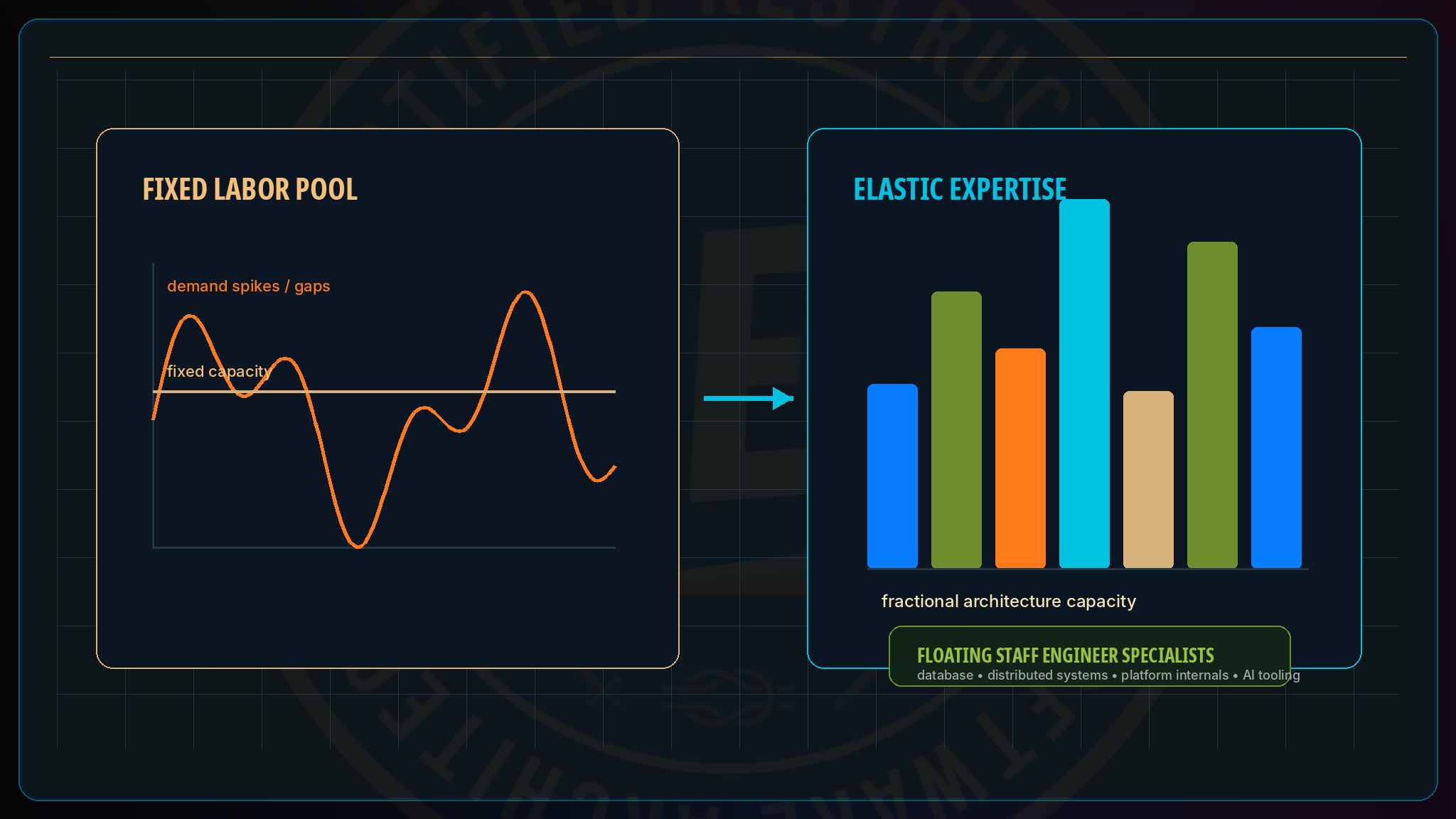
AI-native organizations need elastic access to architectural expertise rather than permanently retained labor pools. As implementation accelerates and commoditizes, architectural judgment becomes disproportionately valuable. Organizations historically scaled software delivery by adding headcount, but AI breaks the assumption that output scales linearly with labor. Small, highly-governed architecture teams now produce output that previously required significantly larger organizations.
The fractional model is older than the current AI wave. True architects have always worked two, three, or four times faster than labor-grade implementation engineers — sometimes more — and this was the original economic basis for fractional architecture engagements long before AI entered the picture. The quiet problem has always been that product backlogs were not built to keep up with that velocity. A capable architect inside a traditional organization would routinely burn through the available specified work faster than the product organization could produce new requirements, then end up either stretched across too many initiatives or under-utilized. Most organizations never recognized this as the symptom of a velocity asymmetry; they read it as the architect being overcommitted, or the team being slow.
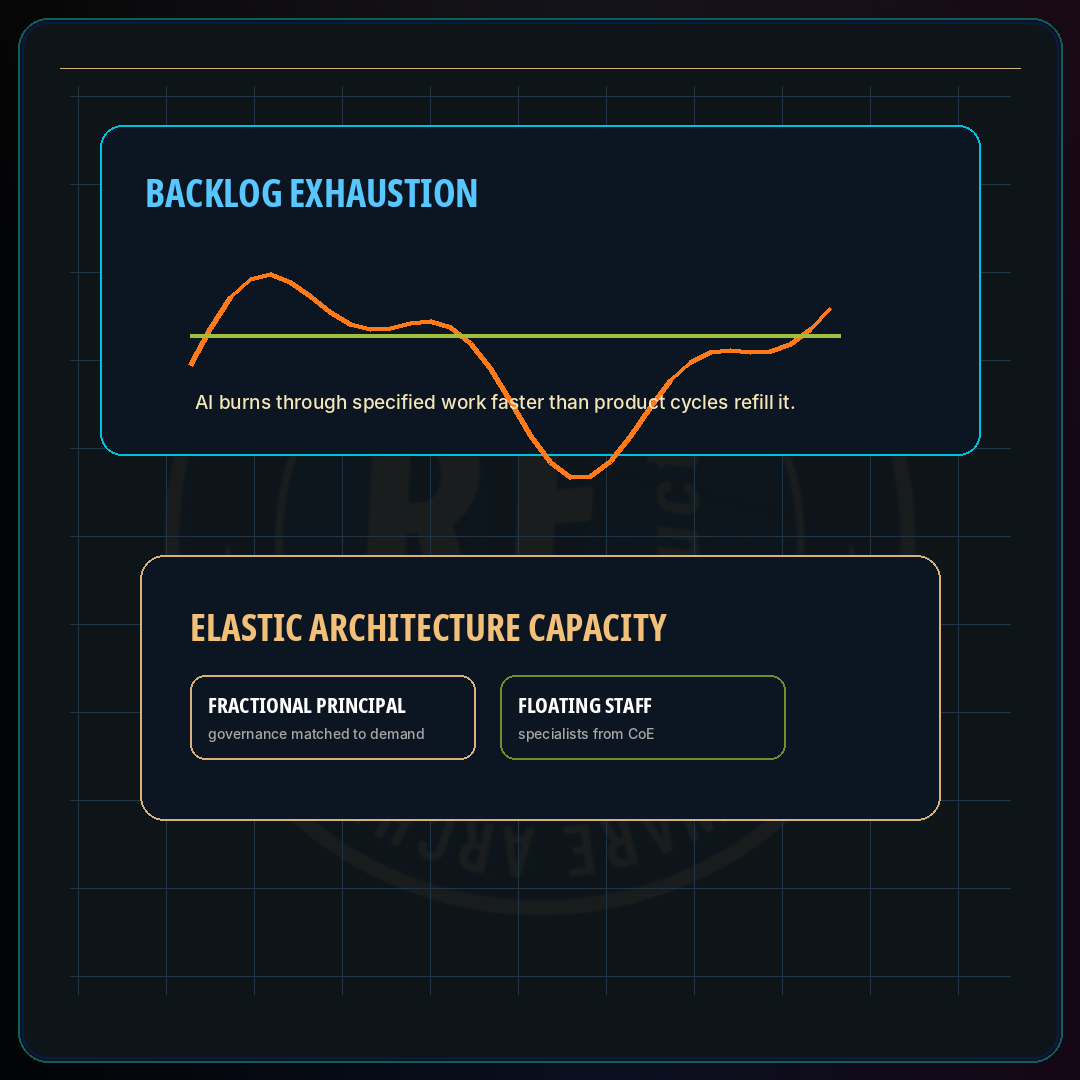
AI has not invented this dynamic. It has surfaced it on a mass scale. Everyone capable of using modern tooling well is now working three to four times faster, sometimes ten times faster, than they were two years ago — but architects are still working faster than that on top. The result is that backlog exhaustion is no longer an exception experienced by a few senior engineers; it is the default operating condition. The narrative that “AI is taking jobs” misreads what is happening. AI is burning through specified work faster than traditional product cycles can replenish it. Operational feedback from production, analytics, and customer behavior in a conventional Agile cadence often takes weeks to inform the next priority, which means there are real workload gaps even inside busy organizations.
Fractional architecture is the natural response. Rather than carrying a permanent surplus of architectural capacity that the product backlog cannot saturate, organizations engage architectural expertise elastically — sized to match actual workload, filling in the gaps that traditional headcount models cannot smooth out. The model is not new. AI has simply made the underlying economics visible to organizations that were previously able to ignore them.
Restruct ™ promotes elastic expertise: fractional architecture retainers, subscription operational models, modernization partnerships, and architecture-as-a-service structures. This is not specifically about consulting firms — it applies equally to SaaS companies, enterprise modernization teams, internal platform groups, and startups. Organizations increasingly purchase judgment, governance, sequencing, and architecture rather than raw implementation hours. The future software economy revolves around governed expertise capacity rather than industrial staffing expansion.
A related elasticity primitive worth naming explicitly: floating Staff Engineers attached to the Center of Excellence. Not every engineer in an organization will want to or should become an architect, and the methodology has been criticized — fairly — for offering a binary path of “become an Associate Architect or leave.” The floating Staff Engineer role is the third option. Staff Engineers do not sit on the Architect ladder; they hold high-leverage technical work that demands deep specialist fluency — database performance, distributed systems, platform internals, AI tooling itself — without being on the architectural-governance track. They float into Architecture Groups when those groups need their specific expertise, and they author production PRs directly because they are senior contributors with system-of-record authorization. This is not a demotion track or an exit ramp; it is an acknowledgment that architectural governance is one valuable function among several, and that organizations adopting Restruct ™ rarely hit 100% Architect-track conversion. The Staff Engineer role is the graceful place to put the engineers the architecture ladder is not the right home for, without losing them or pretending the methodology fits everyone.
© 2024–2026 Vitruvian Technology, Corp. All rights reserved. The Restruct Handbook and its contents are the copyrighted work of Vitruvian Technology, Corp. The handbook may be freely shared and distributed in its complete, unmodified form for educational and informational purposes, provided that all copyright and trademark notices are retained and Vitruvian Technology, Corp. (Vestive) is credited as the source. Excerpts and brief quotations may be used in articles, reviews, presentations, and other commentary with appropriate attribution. Modification, repackaging, or commercial redistribution requires prior written permission. Restruct™ and Certified Restructor™ are trademarks of Vitruvian Technology, Corp. Vestive® is a registered trademark of Vitruvian Technology, Corp. The Restruct™ methodology, the Certified Restructor™ program, and associated trademarks remain the exclusive property of Vitruvian Technology, Corp.