

Restruct stands separately from Vestive intentionally because the Certified Restructor ™ program is calling for a consortium board to help shape and create what this could look like. The rest of this chapter explains why the discipline needs that consortium, what the certification would have to test, and why no single firm — including this one — should own the answer.
For decades, the software industry treated hiring as a solvable interview problem. Organizations built elaborate pipelines of coding screens, algorithm exercises, behavioral interviews, architecture interviews, and panel reviews under the assumption that competence could be reliably compressed into a six-week evaluation loop. Increasingly, that assumption is failing — and not because the interviews are badly run. Architectural judgment is longitudinally observable rather than instantly measurable. The properties that matter most for the Principal Architect role — sequencing discipline, governance quality, operational judgment, subsystem decomposition, communication under ambiguity, product reasoning — emerge over time inside real organizational environments. A candidate can perform well across five interview rounds and prove incapable of governing a production system coherently six months later. Conversely, some exceptional architects perform poorly inside interview structures optimized for implementation trivia, algorithm memorization, or framework recall. Neither failure mode is the candidate’s fault; both are the evaluation method’s fault.
How current hiring breaks down. There is a structural pattern in technical hiring this methodology has to name out loud, because it shows up in nearly every search for senior talent. By the final round, hiring panels typically have two or three candidates who all clear the technical bar — any of them could do the job. The decision then collapses onto the last one percent of differentiation, which the process is not equipped to evaluate. In practice, that one percent gets resolved in one of three ways. The honest version is cultural fit, which is real but unevenly applied. The good version is higher-order soft skills — communication, judgment, leadership posture — which the process can sometimes catch. The third version is the most common and the most damaging: quantitative hedging against uncertainty, dressed up as a meaningful evaluation signal.
The reasoning takes a recognizable shape: years of experience with a particular framework; number of prior employers; keyword familiarity on a resume; narrow implementation history with a specific vendor or stack. “Candidate A has five years of Salesforce experience while Candidate B has two, therefore Candidate A is the safer hire.” It feels like progress on the decision. It is actually surrender. The five-year candidate may have spent those years redoing the same integration project three times under three different managers, while the two-year candidate built two integrations from zero and shipped both. Years-of-experience on its own is not a measurement of capability; it is the metric hiring panels reach for when the real evaluation has stalled and someone needs to feel like a decision was made.
The truth the industry has been avoiding is that you cannot really evaluate this category of talent in six weeks. You can evaluate it in sixty to ninety days of observed work. Everything else is a proxy that breaks down at the senior-architect level. This is why contract-to-hire arrangements consistently produce better senior placements than direct hire — they substitute observation for inference. Without getting into labor law, tax structures, or regional employment mechanics, the underlying logic is straightforward: meaningful architectural evaluation requires real operational exposure. A ninety-day working relationship reveals more about sequencing judgment, communication style, governance discipline, and systems reasoning than five interview rounds ever could. Many organizations quietly recognize this already; contract-to-hire simply formalizes the reality that longitudinal observation is often the only reliable evaluation mechanism for high-trust architectural roles.
This is where the certification argument earns its place. The point of professional certification is not to replace observation. It is to front-load the observation, so the hiring market does not have to repeat it for every candidate at every firm.
What the legal profession actually does. The lawyer analogy gets invoked frequently in this handbook, and it deserves to be developed rather than left as a metaphor. The standard US path to practicing law takes approximately seven years from the start of undergraduate study: four years of bachelor’s work, three years of an ABA-accredited Juris Doctor program, and the bar exam. The bar itself typically takes ten to sixteen weeks of dedicated study after graduation, often four hundred to six hundred hours of preparation. Then a separate ethics exam — the Multistate Professional Responsibility Examination — and a character-and-fitness review with background checks that can take months. Four US states (California, Vermont, Virginia, Washington) maintain apprenticeship-only paths, but these typically require four years of supervised law-office study under a practicing attorney. Whichever path is taken, the institutional commitment is large and deliberate.
What the legal profession is actually buying with all that infrastructure is pre-vetting. By the time a young associate walks into a law firm, the firm knows several things about that person without having to evaluate them directly. An accredited law school faculty has observed them through three years of graded coursework, moot court, and clinical work, and is willing to attach institutional reputation to the degree. The bar exam has tested issue-spotting, rule application, and analysis under timed pressure on real fact patterns. The ethics exam has tested the candidate’s understanding of professional responsibility — not whether they will always behave ethically, but whether they know what ethical behavior in the profession requires. The character-and-fitness review has done a background check. The firm’s evaluation of the candidate is layered on top of all of that, not in place of it.
The economic value of this pre-vetting is enormous and largely invisible. It is what allows law firms to make hiring decisions without each firm independently running a three-year evaluation of every candidate. It is what allows the profession to maintain a recognizable standard of practice across thousands of firms. It is what allows the public, courts, and corporate clients to know what they are buying when they hire a lawyer. The bar is not just a test; it is the load-bearing institution that makes the profession function as a profession.
Medicine applies an even stricter version of the same principle through residency systems and supervised practice. Architecture and civil engineering rely on licensure, apprenticeship, and governed sign-off authority. Each of these professions assumes something software has largely ignored for decades: judgment requires longitudinal evaluation, and the profession itself is responsible for building the institutional structures that produce it.
Software has none of this. A senior engineer applying to a Principal Architect role at a new firm arrives with a resume, a GitHub profile, some references the firm may or may not call, and whatever the six-week interview process can extract. Every firm reinvents the evaluation from scratch. Most firms get it wrong. The methodology this handbook proposes cannot scale on that foundation. It needs the equivalent infrastructure, and the discipline has to build it.
What the bootcamp era actually proved. It is worth confronting the most uncomfortable evidence in favor of the methodology’s central claim, which is the rise of the coding bootcamp. Over the past decade, the industry produced a vocational training pipeline — twelve-to-twenty-four-week programs teaching enough framework fluency for an entry-level full-stack position — and this pipeline became one of the dominant sources of new software labor. The bootcamp industry was not a fringe phenomenon. It absorbed career-switchers, replaced significant fractions of traditional CS hiring at some companies, and helped flood the market with engineers carrying the “full-stack” label.
The bootcamp boom validates a claim this handbook has been making throughout: a substantial fraction of software work over the past decade was, in fact, vocational labor. Twelve weeks of structured training was enough to participate in it. Trade schools exist for vocational labor; they do not exist for professional disciplines. Nobody runs a twelve-week bar prep program that produces a practicing attorney, because being a lawyer requires institutional formation that twelve weeks cannot deliver. The fact that twelve weeks produced functional full-stack developers tells us something honest about what most full-stack work actually was.
This is not a criticism of the people who came through bootcamps; many of them are excellent at the work they were trained for. It is a structural observation about what kind of work the discipline was producing during that period. The bootcamp era proved that one tier of software work had genuinely commoditized to the point where vocational training was adequate. AI is now absorbing that tier directly, which is exactly the dynamic the rest of this handbook addresses.
The architectural tier the methodology calls for is not that tier. It cannot be produced in twelve weeks, and it should not pretend to be. If bootcamps were the institutional response to a vocational layer of the discipline, the Certified Restructor ™ program — or whatever its eventual form — is the institutional response to the professional layer of the discipline. The two are not in tension. They describe two different categories of work that the industry has historically conflated under one job title, and the conflation is what the methodology is trying to resolve.
Bootcamps are to vocational software labor what the Certified Restructor ™ program is to AI-era software architects.
That symmetry is the clearest possible argument that the professional tier needs the institutional infrastructure the vocational tier never required.
What certification would actually test. A serious Certified Restructor ™ program — or any equivalent the discipline ends up building — has to test the work the methodology actually depends on, not the work that traditional technical hiring measures. The testable disciplines, drawn from the chapters of this handbook, include at minimum: risk analysis, subsystem decomposition, specification clarity and contract definition, sequencing judgment, governance under production pressure, AI orchestration discipline, and architectural communication.
Risk analysis asks the candidate to evaluate a proposed change against the system’s blast radius — what fails if the implementation is wrong, who notices, how fast it compounds, and whether the failure is recoverable. The grading criterion is whether the candidate can name the real risks before writing any code, and propose a sequencing or scoping change that reduces blast radius without sacrificing the underlying objective.
Subsystem decomposition asks the candidate, given a poorly-bounded legacy system and a product requirement, to identify the seams, propose a decomposition, defend the boundary choices, and produce the specification for the first Architecture Group’s first deliverable. This is gradable. Experienced practitioners can evaluate whether a candidate’s seams are clean, whether the decomposition will hold under predictable future requirements, and whether the specification is precise enough for AI execution. It cannot be evaluated in forty-five minutes; it can be evaluated in a structured proctored environment of meaningful duration.
Specification clarity asks the candidate, given a desired subsystem behavior, to produce the interface contract, the data model, the operational boundaries, and the acceptance criteria. The grading criterion is whether the specification is unambiguous enough that two different competent implementers — human or AI — would produce compatible systems from it. Sequencing judgment asks the candidate, given a backlog of dependent work, to produce a sequencing plan that respects technical dependencies, business priorities, and capacity constraints, defending the sequencing under scrutiny from examiners who will probe the tradeoffs.
Governance under production pressure is the architectural equivalent of the bar exam’s ethics component. Given a scenario in which a Principal Architect is asked to ship a change that bypasses governance — under deadline, under executive pressure, under a sympathetic edge case — the candidate demonstrates the response. The question is not whether the candidate will always make the right call in practice. The question is whether they recognize the call as one that needs to be made. AI orchestration discipline asks the candidate to demonstrate the ability to scope an AI execution session against a bounded specification, to recognize when the AI is drifting from the specification, to stop and recompose rather than rubber-stamp, and to maintain context coherence across sessions — a discipline that did not exist five years ago and that the industry currently has no standard way to evaluate. Architectural communication asks the candidate to defend a decision to a non-technical stakeholder, to a peer Principal Architect who disagrees, and to a junior Associate who needs to learn from it: three different audiences, three different registers, one underlying decision.
These are not the only disciplines that matter, but they are the load-bearing ones for the role the methodology defines. Each of them is gradable by experienced practitioners. None of them are gradable in a forty-five-minute screen. The right form for the evaluation is a multi-day proctored environment with structured exercises, examiner panels, and scenarios that put the candidate under the kind of pressure the actual role generates, but administered in a fair and realistic way, leveraging AI utility.
Software has vendor-specific and process-framework certifications, but no real practitioner-level professional certification for AI-era architects with the institutional weight of law/medicine or a PE license.
Enterprise architecture frameworks like TOGAF and Zachman already provide foundational vocabulary and process discipline for systems-level architectural thinking. Vendor and platform certifications (AWS, Salesforce, Cisco, framework and database credentials) are also valuable.
The Certified Restructor ™ program should build on this rather than displace it. Foundational frameworks like TOGAF or Zachman are reasonable prerequisites for Principal-level certification — the candidate is expected to have already internalized enterprise-architecture vocabulary before being evaluated on AI-era judgment. Associate-level certification can be more lax on prerequisites, since the program functions partly as training.
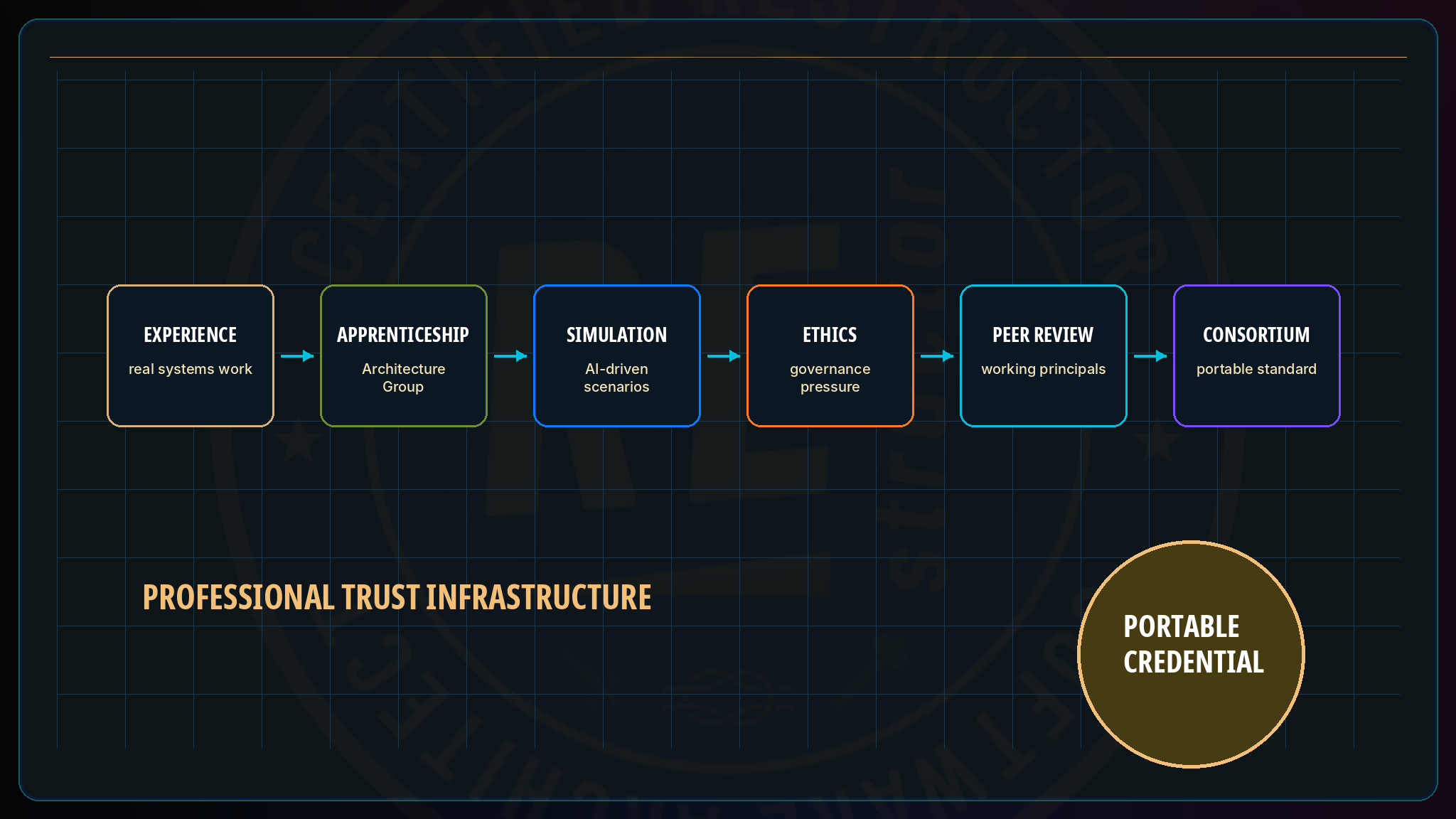
Why a single exam is the wrong shape. A common misreading of professional certification is that the credential is the exam. It is not. The exam is one component of a layered evaluation system, and the layering is what makes the credential meaningful. Law combines accredited education, supervised clinical work, a substantive bar exam, a separate ethics exam, and character-and-fitness review. Medicine combines accredited education, board exams, supervised residency, and continuing certification. Architecture combines accredited education, supervised internship hours, multi-division licensure exams, and state registration. Each profession has converged on roughly the same insight: written tests evaluate knowledge, but professional judgment requires layered evaluation across multiple modalities and meaningful elapsed time.
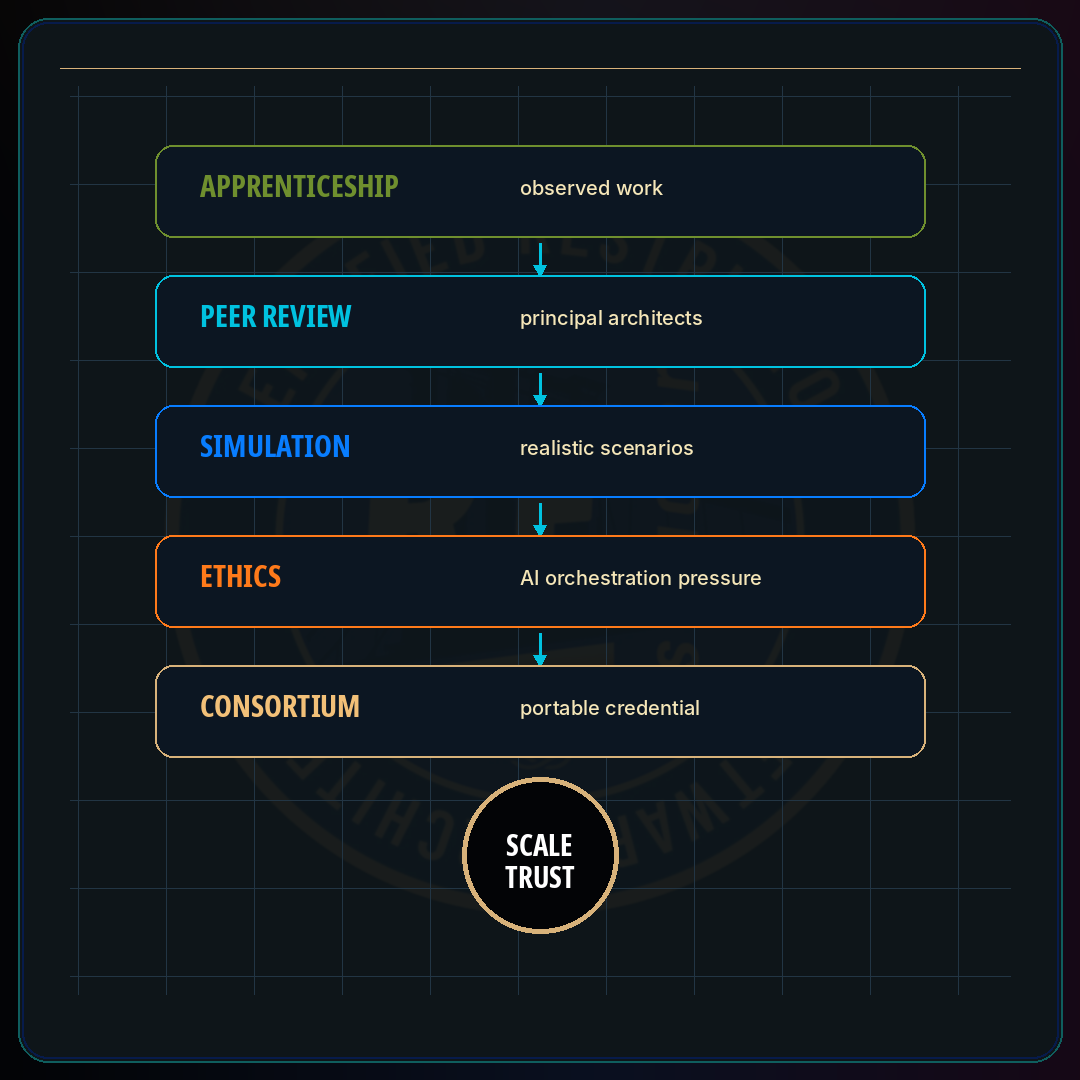
The Restruct equivalent should follow the same shape. Apprenticeship inside an Architecture Group, peer review by working Principal Architects, supervised execution against real or realistic systems, ethics assessment specifically tuned to AI orchestration discipline, operational simulation, and progressively increasing authority boundaries as trust is earned. The future equivalent of architectural licensure in software may look less like a one-time exam and more like a governed progression system where authority expands over time. That progression is what the Associate-to-Principal pathway described throughout this handbook is already gesturing at. The certification’s job is to formalize that progression and make it portable across firms.
How AI changes what’s possible. The legal profession built its evaluation infrastructure over more than a century, and the duration of apprenticeship reflects what was institutionally possible at the time. Three years of law school and four years of supervised apprenticeship in apprentice-path states are two solutions to the same observation problem. The duration is not a law of nature; it is what the available evaluation technology required.
Software has an opportunity the legal profession did not have when it built the bar: AI itself can be used to compress the observation window. A sufficiently rich AI-driven simulation environment can stand up realistic architectural scenarios on demand — fake codebases with realistic histories, fake stakeholders with realistic positions, fake production incidents with realistic time pressure, fake AI execution sessions that drift in realistic ways. Candidates can be observed working through these scenarios over thirty to sixty days of structured evaluation rather than three to seven years of formal education and supervised practice. The observation is still real; the medium changes.
This is not a claim that thirty to sixty days of AI-proctored simulation replaces years of professional formation. It replaces the observation component, which is the rate-limiting step in current certification design. A candidate with ten years of real systems experience can demonstrate that capability in simulation far faster than one with zero. The certification surfaces experience; it does not manufacture it. The same scenarios that evaluate a senior practitioner also train a developing one.
The downstream effect, if this works, is significant. The talent acquisition industry currently absorbs enormous cost running parallel evaluation processes that produce inconsistent results: HR teams interview, hiring managers re-interview, technical screens duplicate effort across firms, and nothing portable results. A certified candidate arriving on the job market is pre-vetted — not perfectly, but meaningfully — which compresses the hiring process and shifts the firm’s evaluation onto the genuine last-mile concerns of fit, team chemistry, and domain specifics.
This matters more in AI-native environments than in any prior era of software, because the blast radius of weak sequencing, fragmented subsystem ownership, incoherent AI orchestration, or poor contract definition expands significantly when implementation itself becomes near-instantaneous. The industry therefore needs stronger institutional trust systems around who is permitted to govern those environments.
Why this cannot be a Vestive program. The most important structural feature of the certification this handbook calls for is that it cannot be owned by any single firm — including Vestive. The legitimacy of professional certification depends on its independence from the commercial interests that benefit from it. The American Bar Association is not Cravath. NCARB is not SOM. The Project Management Institute survived because it was a membership organization, not a consultancy’s credential. Conversely, certifications that remain proprietary to a single firm — even when the underlying methodology is sound — get treated as marketing rather than as professional credentials, and they do not travel.
The Restruct methodology and the Vestive firm are deliberately separate entities for exactly this reason. Restruct is a methodology proposal. Vestive is one firm that practices it, contributed to developing it, and is willing to do the unglamorous early work of bootstrapping the institutional infrastructure on the discipline’s behalf. The intent is for the Certified Restructor ™ program to migrate to an independent consortium body as the field matures — a board comprising practicing firms, academic institutions, and individual practitioners who collectively own the certification, set the standards, administer the examinations, and govern the program’s evolution.
A practical note on the institutional bridge. The Certified Restructor ™ trademark currently sits with Vitruvian Technology, Corp., the entity from which the methodology emerged. This is a temporary arrangement, not a permanent one — the WordPress pattern is instructive here, where the WordPress trademark is held by the WordPress Foundation as a non-profit steward of the open community, separate from any single commercial implementer. The intent is that the Certified Restructor ™ trademark transfer to, or be licensed in perpetuity to, the consortium body once that body is constituted as a standing non-profit. In the interim, VitruvianTech holds the mark in trust on behalf of the discipline, not as a commercial asset, and is committed to that transfer on reasonable terms when the consortium is established. The same separation that protects the WordPress community from commercial capture by any one firm is what protects the Restruct discipline from the same risk.
This handbook is therefore not announcing a finished certification program. It is issuing a call for the consortium that would build one. The shape of that consortium is itself a question the field has to answer: whether it looks more like NCARB (federation of state-level bodies), more like the ABA (a single national professional association), more like IEEE (a standards organization that accredits but does not directly administer), or something new that fits the AI era specifically. Each model has tradeoffs. None of them are unprecedented in adjacent professions. The discipline of software is overdue to have this conversation in earnest.
The honest acknowledgment is that this will take time. The legal profession’s institutional infrastructure was built over more than a century, with significant variation and false starts along the way. The architecture profession took roughly forty years between its founding professional association and its first state regulatory body — about the time the commercial software industry is at now . A credible Certified Restructor ™ program is the work of years, not quarters. It will not be credible at launch. The first cohorts will be evaluated against criteria the discipline will subsequently refine and disagree with. Grandfathering early Principal Architects who built the systems before the certification existed will be a real problem, just as it was for every prior professional licensure regime. None of these difficulties are reasons to delay starting; they are reasons to start with realistic expectations.
What this means for the methodology. The certification problem and the methodology are inseparable. The methodology depends on a Principal Architect role that the industry currently cannot reliably hire for. The honest response to that gap is not to dilute the role, lower the bar, or pretend conventional interview processes are adequate. It is to build the institutional infrastructure adjacent professions built decades ago.
This is what professional maturity looks like. The early phase of any discipline runs on personal reputation, word-of-mouth, and the willingness of senior practitioners to vouch for emerging ones. That phase is sustainable up to a certain scale, and software has been running on it for longer than it should have. The next phase is institutional: formal evaluation, credentialing bodies, apprenticeship structures, ethics standards, and an accepted vocabulary that allows the profession to talk about itself with precision. Law, medicine, architecture, and engineering all built this infrastructure when their disciplines matured. Software has been the conspicuous holdout, and the AI era is finally making the cost of the holdout visible.
The end goal of architecture governance that the methodology calls for should also begin with governance during talent development and assessment, to close the loop.
The Certified Restructor ™ program is one firm’s contribution to closing that gap, offered openly to the consortium the discipline now needs to convene. Other firms, institutions, and practitioners are explicitly invited to refine, contest, and ultimately own the result. The methodology proposed in this handbook is stronger, not weaker, when the certification that backs it is held by the field rather than any single contributor.
The software industry spent decades scaling labor. The AI era needs to be focused on scaling trust.
© 2024–2026 Vitruvian Technology, Corp. All rights reserved. The Restruct Handbook and its contents are the copyrighted work of Vitruvian Technology, Corp. The handbook may be freely shared and distributed in its complete, unmodified form for educational and informational purposes, provided that all copyright and trademark notices are retained and Vitruvian Technology, Corp. (Vestive) is credited as the source. Excerpts and brief quotations may be used in articles, reviews, presentations, and other commentary with appropriate attribution. Modification, repackaging, or commercial redistribution requires prior written permission. Restruct™ and Certified Restructor™ are trademarks of Vitruvian Technology, Corp. Vestive® is a registered trademark of Vitruvian Technology, Corp. The Restruct™ methodology, the Certified Restructor™ program, and associated trademarks remain the exclusive property of Vitruvian Technology, Corp.