

The methodology has been described throughout this handbook as AI-first, and the rest of the document assumes agentic AI as the default implementation layer. This appendix is included as evidence that the governance pattern itself works without that assumption. The case study below was delivered before agentic AI was operationally available, and the velocity and quality results came from the architectural discipline alone. What AI changes is the speed at which the same pattern compresses further; what the methodology actually requires is the governance.
Project scope
The engagement was a modernization of a publicly traded Fortune 500 company’s high-stakes, revenue-sensitive cost-center, billing, and sales-order system. The legacy system was operationally critical, customer-facing in its downstream effects, and carried the kind of audit, accuracy, and compliance constraints that make this category of work particularly intolerant of defects. Modernization had been attempted previously through conventional staffing models and had stalled.
Team composition
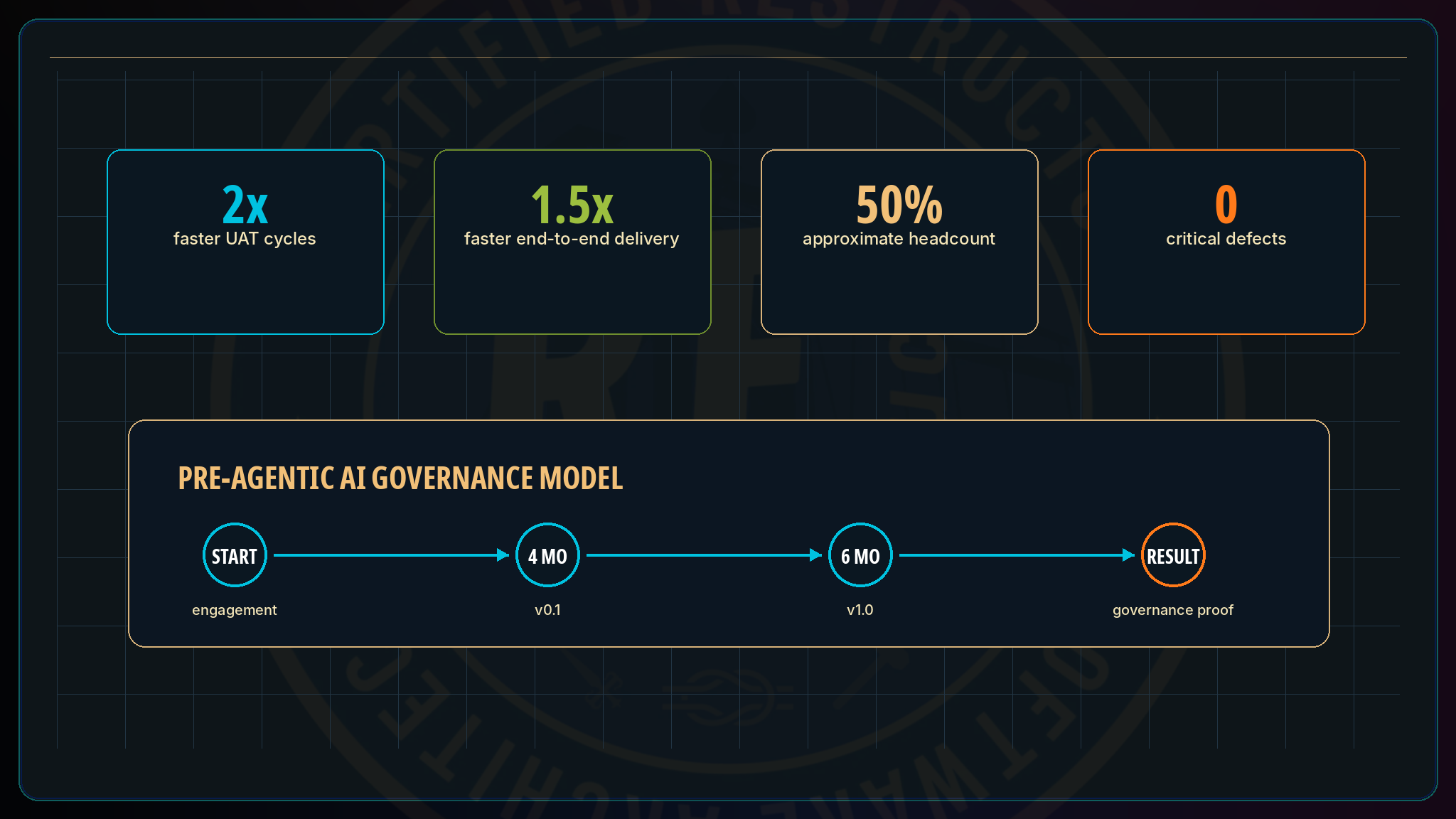
One Principal Architect and one Assistant Principal Architect. No additional Associates, no embedded engineering managers, no scrum masters, no Agile release train. This was the entire delivery team for the architectural and execution layer. The arrangement predates agentic AI tooling, so all implementation work was human-authored under direct architectural sequencing.
Delivery timeline
Four months from engagement start to v0.1 delivery. Two additional months to v1.0. Cadence ran on three-week cycles of stakeholder demos and follow-ups rather than daily standups. The longer cycle was workable because architectural sequencing made the work predictable enough to plan in three-week increments rather than re-plan every morning; the stakeholder cadence was set by what the business needed to see, not by what the engineering team needed to coordinate.
Outcomes
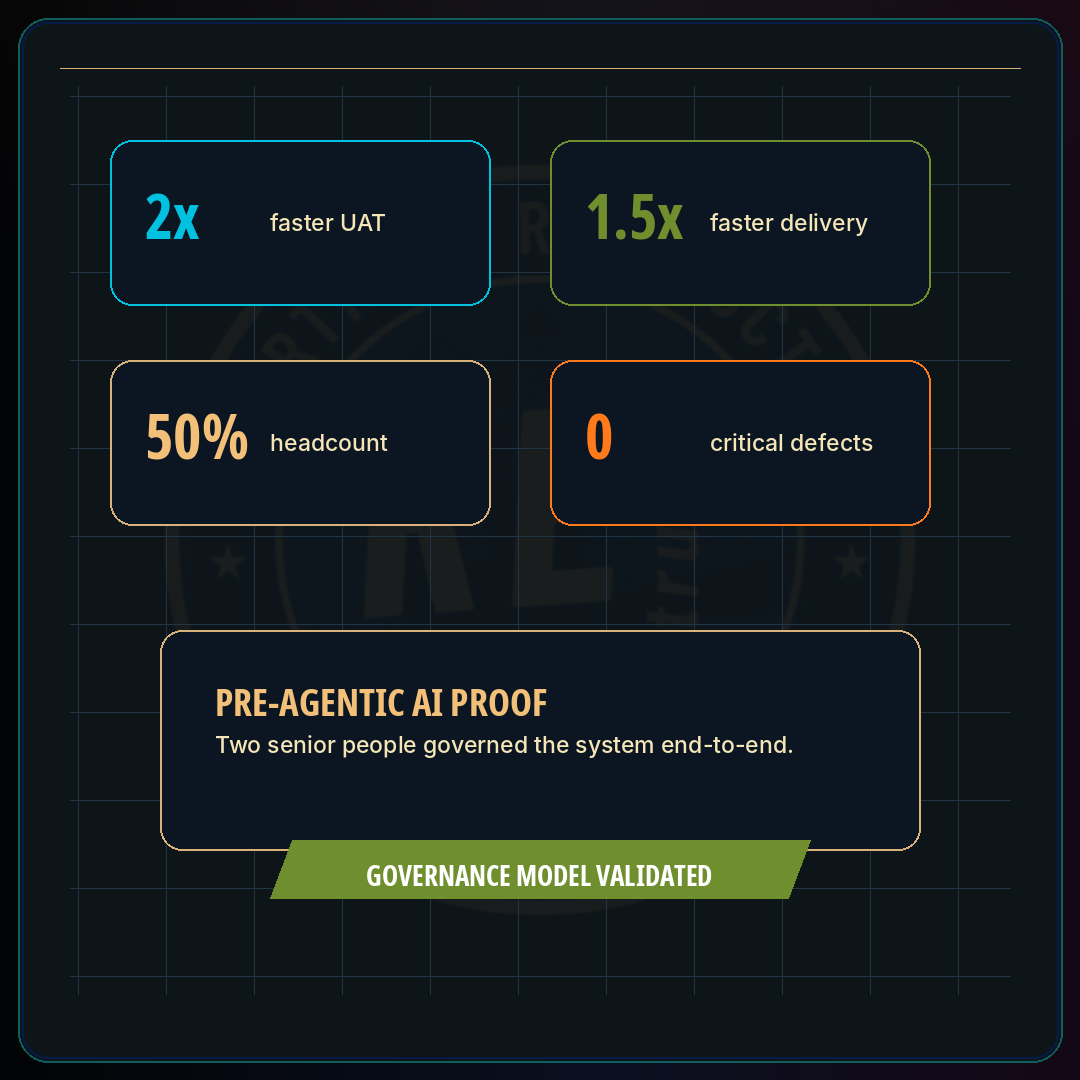
Compared against other non-Restruct ™ teams running similar-scale projects inside the same organization: approximately 2x faster UAT cycles with zero critical defects, approximately 1.5x faster end-to-end delivery, and roughly 50% of the headcount. The defect number is the most consequential: in this category of work, a critical defect in production has direct revenue and compliance exposure, so zero critical defects across UAT and initial production deployment was both unusual and load-bearing for the engagement’s credibility.
Why this matters
The engagement shipped before agentic AI tooling was generally available. The velocity and quality results came from architectural concentration and specification discipline alone — two senior people who governed the system end-to-end produced outcomes that staffing-heavy comparable teams could not match. This is the strongest available evidence that the methodology’s core claim is structural rather than tooling-dependent: AI accelerates the same pattern further, but the pattern works without it. Organizations that adopt Restruct ™ today inherit the AI-era compression on top of an already-validated governance model.
© 2024–2026 Vitruvian Technology, Corp. All rights reserved. The Restruct Handbook and its contents are the copyrighted work of Vitruvian Technology, Corp. The handbook may be freely shared and distributed in its complete, unmodified form for educational and informational purposes, provided that all copyright and trademark notices are retained and Vitruvian Technology, Corp. (Vestive) is credited as the source. Excerpts and brief quotations may be used in articles, reviews, presentations, and other commentary with appropriate attribution. Modification, repackaging, or commercial redistribution requires prior written permission. Restruct™ and Certified Restructor™ are trademarks of Vitruvian Technology, Corp. Vestive® is a registered trademark of Vitruvian Technology, Corp. The Restruct™ methodology, the Certified Restructor™ program, and associated trademarks remain the exclusive property of Vitruvian Technology, Corp.