

Pricing is part of the methodology, not an afterthought to it. The rate a firm charges for a Principal Architect or Associate Architect engagement is itself an institutional signal: it tells buyers what category of work they are purchasing, anchors their evaluation criteria, and disciplines the firm’s own selection of who can hold the role. Underpricing collapses the methodology into senior contracting; overpricing without the brand to support it collapses the firm. This appendix offers a framework for thinking about pricing rather than a specific rate card. Firms running the methodology will arrive at different numbers depending on their market, brand maturity, and regional cost structures, but the principles below should hold across implementations.
A note on time-anchoring: the reference points discussed below — senior independent contractor pricing, strategy consulting band rates, loaded-cost ratios, and the maturity stage of the Restruct ™ methodology itself — are anchored to 2026 market conditions. Professional-services pricing drifts year over year, and the relationships between bands can shift as adjacent markets revalue. Readers consulting this appendix in later years should treat the specific bands as historical benchmarks and the underlying principles — retainer over hourly, ratios that signal hierarchy, loaded-cost math against replaced roles — as the durable content.
Pricing format: retainer first, hourly second
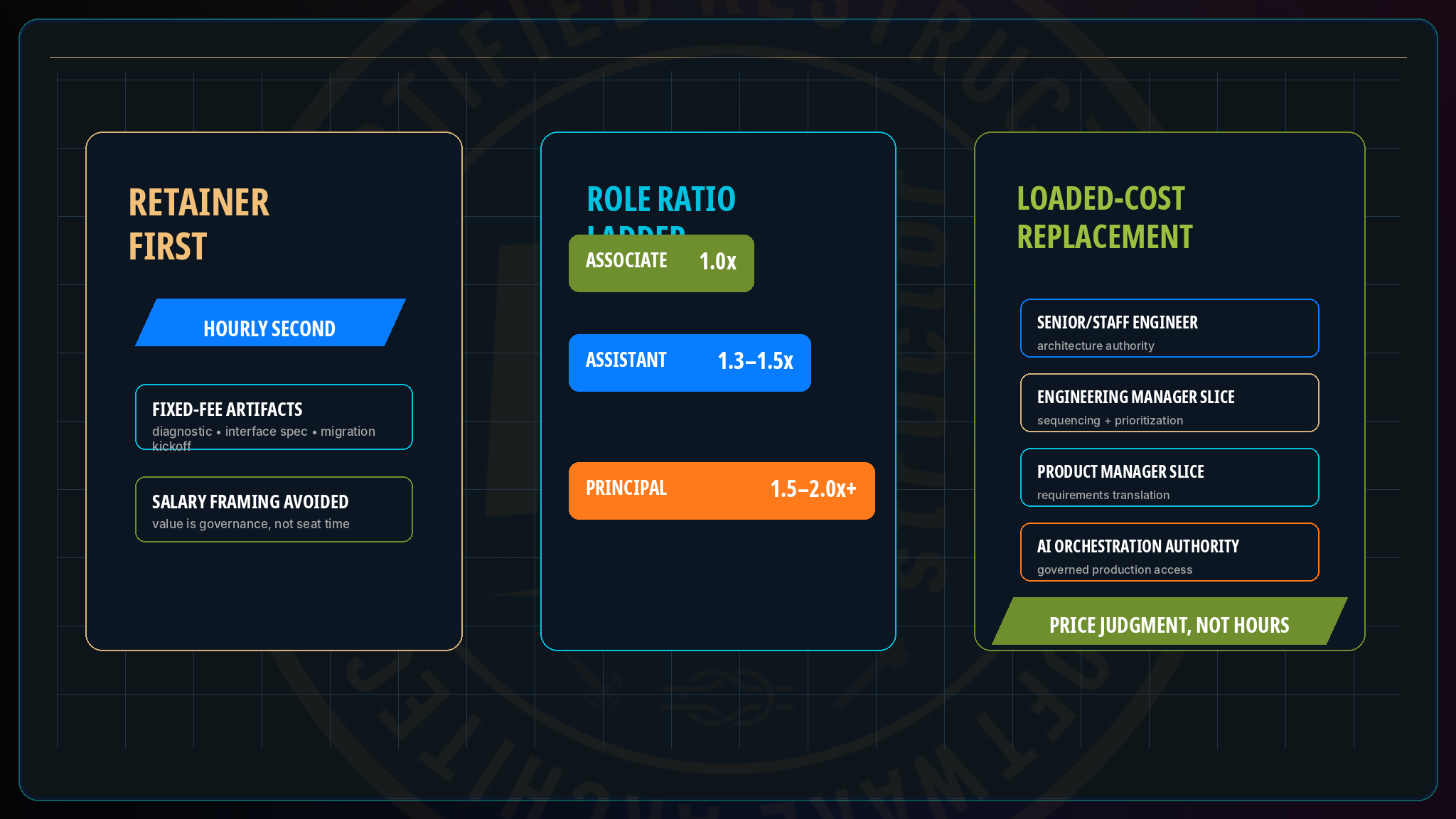
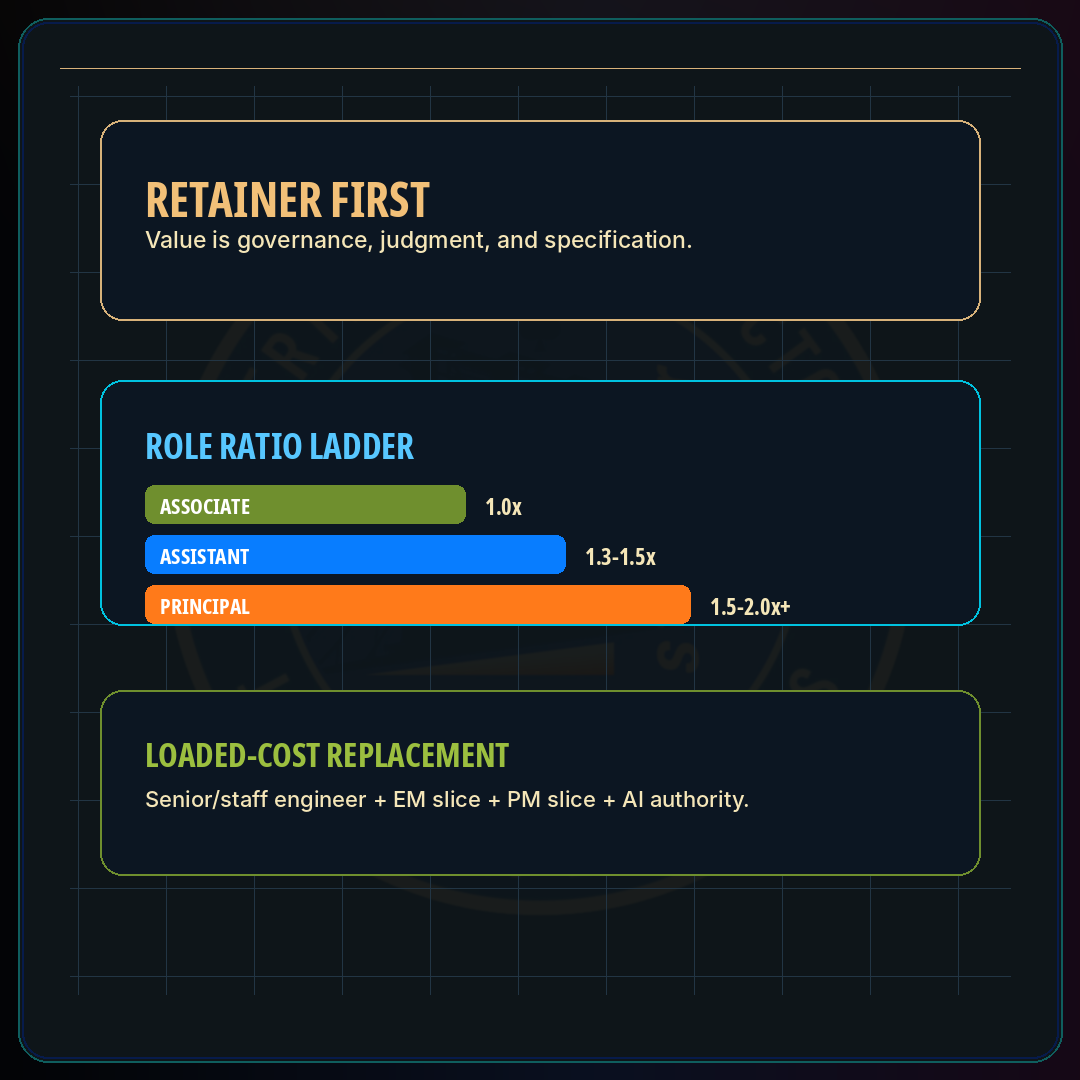
The methodology argues throughout that software value is governance, judgment, and specification rather than hours. The pricing format has to match that argument or the document contradicts itself. The recommended approach is to lead with retainer or flat-fee pricing — scoped engagements like “Principal Architect governing subsystem X” or “Associate Architect supporting specification drafting under Principal Architect [name]” — and publish hourly rates as a secondary breakdown unit for buyers who need to check the math. Salary-equivalent figures should appear only in comparative loaded-cost arguments that justify a retainer’s price against the in-house roles it replaces, never as the headline pricing format. Salary framing implies full-time employment with benefits, retention math, and equity conversations the methodology is explicitly trying to move past.
For organizations not ready for a retainer, fixed-fee deliverable pricing — billed against a named artifact such as a subsystem interface specification, an architectural diagnostic, or a migration kickoff — provides a sized entry point and reinforces the specification-over-labor framing. Fixed-fee deliverable engagements also build a portfolio of priced artifacts the firm can reference when scoping larger retainers.
The three reference anchors
Three reference points should inform Principal Architect pricing, and the rate has to land defensibly against all three rather than just the most flattering one.
The first is senior independent contractor pricing. The Principal Architect rate must land clearly above this band. If a buyer can engage a strong senior engineer at the same rate, the Principal Architect title reads as a rebrand rather than a different category of work — and the methodology’s entire argument about governance being distinct from labor collapses. The premium has to be visible.
The second is strategy consulting pricing — the McKinsey, Bain, and BCG band. Principal Architects should land clearly below this. Strategy firms charge what they do partly because they sell to C-suite buyers on brand and partly because their deliverables are decks and recommendations rather than embedded operational governance. Restruct ™ Principal Architects are embedded operators, not slide-makers, and pricing into the strategy-firm band without the brand to support it invites scrutiny the engagement cannot withstand.
The third is the loaded cost of the in-house roles the Principal Architect actually replaces. In a typical mid-sized organization, the Principal Architect is absorbing the scope of a senior or staff engineer (architecture authority), a meaningful slice of an engineering manager (sequencing and prioritization), a slice of a product manager (operational intent and requirements translation), and the AI orchestration scope that no other role in the organization is permitted to hold. The retainer should price somewhere above the loaded cost of the named senior engineer alone and meaningfully below the combined loaded cost of all the roles the position is collapsing. This is the math that makes the engagement defensible: the buyer is paying more than one senior engineer would cost and substantially less than the team the role replaces.
Role ratios and what they communicate
The ratios between role prices encode the methodology’s argument about hierarchy more clearly than absolute numbers do. A reader looking at a rate card can tell at a glance whether a firm is selling a real hierarchy with distinct authority levels or three labels on similar work. Mature professional-services categories — law firms, architecture firms, accounting partnerships — run partner-to-associate billing rate ratios in the 2.5x to 3.5x range. That spread reflects decades of brand accumulation and a clear social understanding that partner-tier work is categorically different from associate-tier work.
Restruct ™ firms entering the market are unlikely to be able to support those ratios immediately. The Certified Restructor ™ program, the methodology’s public footprint, and the case studies that justify a wide partner premium all take time to build. A reasonable target structure for a firm in market-entry stage is roughly:
• Associate Architect: 1.0x (the baseline)
• Assistant Principal Architect: ~1.3x to 1.5x of Associate
• Principal Architect: ~1.5x to 2.0x of Associate at market entry, widening toward 2.5x or beyond as brand and demand mature
A compressed Principal-to-Associate ratio at market entry is a defensible choice rather than a weakness. It reflects that the methodology is an emerging discipline rather than an established one, that the Principal premium has not yet been validated by mass-market case studies, and that early adopters are essentially taking on category-formation risk. The honest framing — explicitly naming that the ratio is current-stage pricing and is expected to widen as the methodology matures — is itself a credibility signal. It tells buyers the firm has thought about its positioning and is not pretending to have brand authority it has not yet earned.
The loaded-cost argument
The most defensible justification for any Principal Architect rate is a comparative loaded-cost calculation against the in-house roles the engagement replaces. The template, applicable in any market:
• Loaded cost of a senior or staff engineer (base salary plus benefits, payroll taxes, equipment, and overhead — typically 1.3x to 1.5x of base) — the architecture-authority role being absorbed
• A proportional slice of an engineering manager’s loaded cost (typically 25% to 40% of that role’s loaded cost) — the sequencing and prioritization function
• A proportional slice of a product manager’s loaded cost (typically 15% to 25%) — the operational intent and requirements translation function
• The marginal value of AI orchestration authority that no other role in the organization is permitted to hold (difficult to price directly but real)
Summing the first three components produces a defensible upper bound for what a buyer is currently spending on the equivalent in-house scope. A Principal Architect retainer priced below that sum is, on paper, a cost reduction even before any throughput argument is applied. The throughput argument from Chapter 10 — that a single Principal Architect orchestrating a well-scoped subsystem can deliver, for known-pattern work, what a ten-person engineering team previously delivered — only strengthens the math. When both arguments are made together, the retainer is meaningfully cheaper than the named roles it replaces while delivering substantially more output than the team it replaces. That is the argument the pricing has to carry.
Two cautions
First, the pricing assumes the methodology is being run well. A Principal Architect rate is defensible only when the person holding the role is genuinely doing the collapsed-role work the methodology describes. If a buyer scrutinizes the engagement and discovers a senior engineer with a fancy title, the rate becomes indefensible at the moment of scrutiny — and the damage extends beyond the individual engagement to the entire category. Firms running the methodology must be willing to leave a Principal Architect role unfilled rather than fill it with someone who cannot carry it.
Second, Associate Architects should not be priced into apprenticeship-tier territory in pursuit of competitive wins. There is a tempting argument that pricing Associates at junior-contractor rates will accelerate engagement volume; in practice it positions the firm as a body shop and makes the methodology indistinguishable from offshore contracting. The Associate rate must clear the band where buyers default to comparing against junior contractors, and the supervision the Associate receives from a Principal Architect must be real rather than nominal. The most damaging engagement pattern is a client buying an Associate at Associate prices while the Principal is pulled into other accounts and the Associate effectively runs solo. That pattern produces lower-quality output, undermines the methodology, and trains buyers to believe Associate-level work is what the methodology produces. The Principal supervision is what makes the Associate rate defensible. Without it, the rate is not.
© 2024–2026 Vitruvian Technology, Corp. All rights reserved. The Restruct Handbook and its contents are the copyrighted work of Vitruvian Technology, Corp. The handbook may be freely shared and distributed in its complete, unmodified form for educational and informational purposes, provided that all copyright and trademark notices are retained and Vitruvian Technology, Corp. (Vestive) is credited as the source. Excerpts and brief quotations may be used in articles, reviews, presentations, and other commentary with appropriate attribution. Modification, repackaging, or commercial redistribution requires prior written permission. Restruct™ and Certified Restructor™ are trademarks of Vitruvian Technology, Corp. Vestive® is a registered trademark of Vitruvian Technology, Corp. The Restruct™ methodology, the Certified Restructor™ program, and associated trademarks remain the exclusive property of Vitruvian Technology, Corp.