

Chapter 3 made the case that the forty-hour office model is wrong for cognitive work and proposed a shift-based rhythm in its place. This chapter is about where that rhythm gets executed. Shift-based work and remote-first are inseparable in practice: the morning deep-focus window, the midday recovery, the evening sync — none of these survive a five-day commute to a centralized building. Location is the operational expression of the cognitive model.
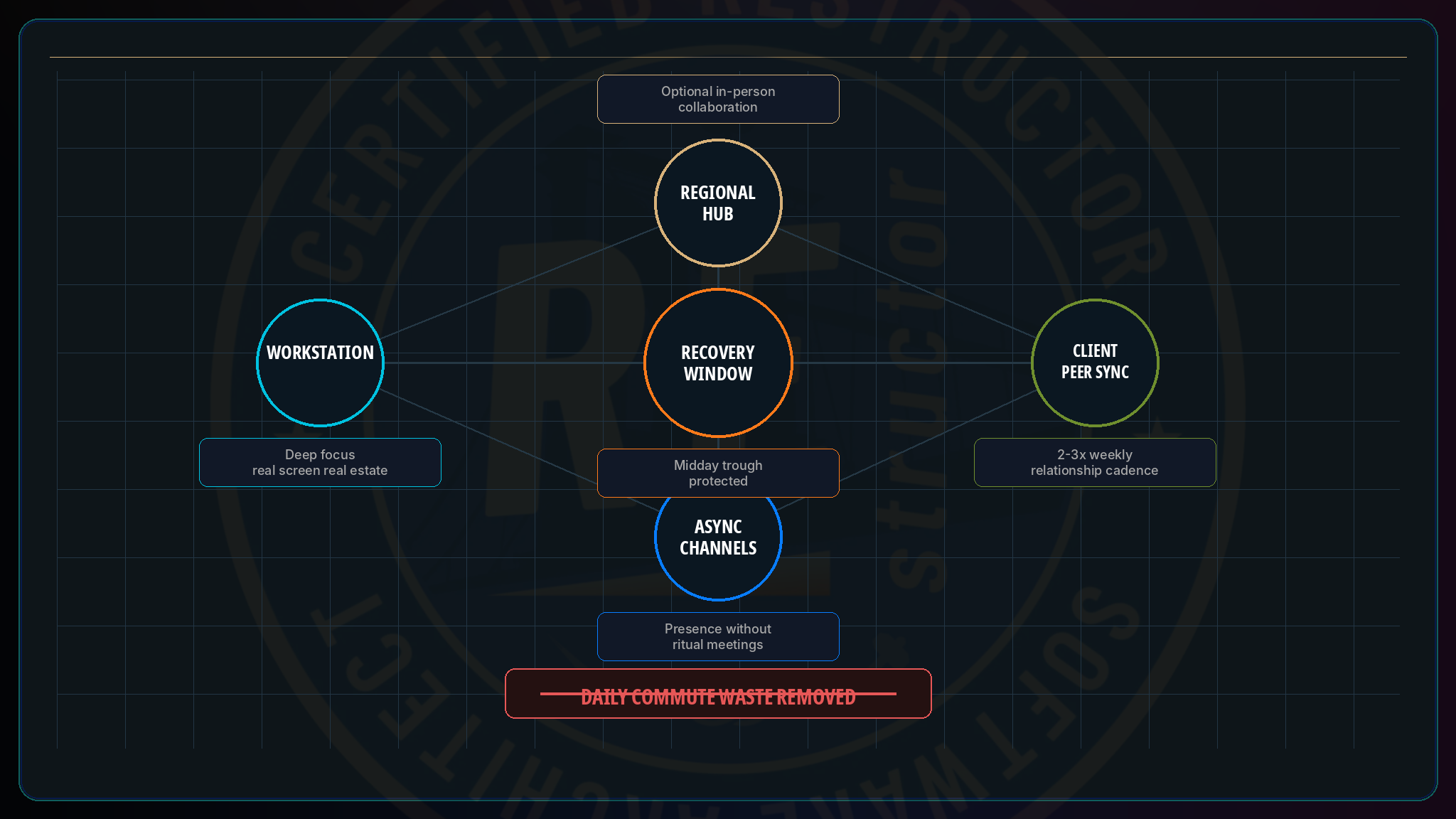
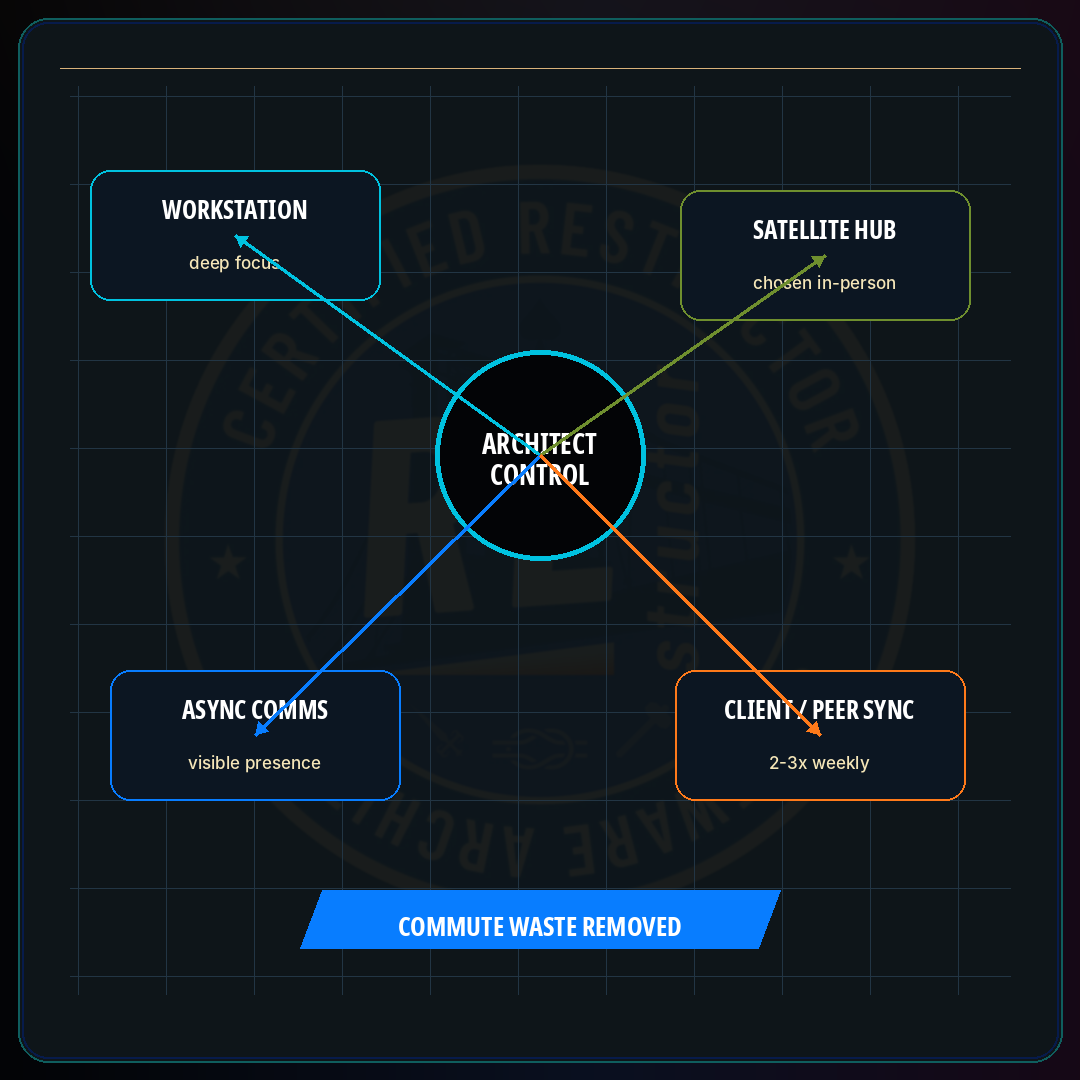
It is worth being precise about what remote-first does and does not mean, because the term has been caricatured in both directions. Humans like to be social. Engineers like to talk shop in person when it is convenient and arbitrary rather than mandated and scheduled. Remote-first preserves exactly that. What it removes is the wasteful compulsory version — the five-day-a-week commute to a centralized building so that people can sit near each other while wearing headphones to avoid distraction. Equally, remote-first does not mean working in pajamas from bed on a thirteen-inch laptop. Cognitive performance work requires the same seriousness of setup as any other professional craft: a real workstation, real screen real estate, an environment built for sustained focus. The point of remote-first is to put the architect in control of when human contact, deep focus, and recovery happen — not to abolish any of them.
The methodology is not anti-human-interaction. Smaller regional satellite hubs near where people actually live often encourage more meaningful hybrid collaboration than forcing entire cities into wasteful daily commutes. A satellite that someone can reach in fifteen minutes by choice produces better in-person time than a headquarters someone reaches in ninety minutes by mandate.
A rule around etiquette: remote-first does not mean be invisible. Be active on communication tools, meet with peers, managers, and clients at least 2-3x per week. Even if nothing is urgent, being present is just a matter of respect to those around you.
© 2024–2026 Vitruvian Technology, Corp. All rights reserved. The Restruct Handbook and its contents are the copyrighted work of Vitruvian Technology, Corp. The handbook may be freely shared and distributed in its complete, unmodified form for educational and informational purposes, provided that all copyright and trademark notices are retained and Vitruvian Technology, Corp. (Vestive) is credited as the source. Excerpts and brief quotations may be used in articles, reviews, presentations, and other commentary with appropriate attribution. Modification, repackaging, or commercial redistribution requires prior written permission. Restruct™ and Certified Restructor™ are trademarks of Vitruvian Technology, Corp. Vestive® is a registered trademark of Vitruvian Technology, Corp. The Restruct™ methodology, the Certified Restructor™ program, and associated trademarks remain the exclusive property of Vitruvian Technology, Corp.