

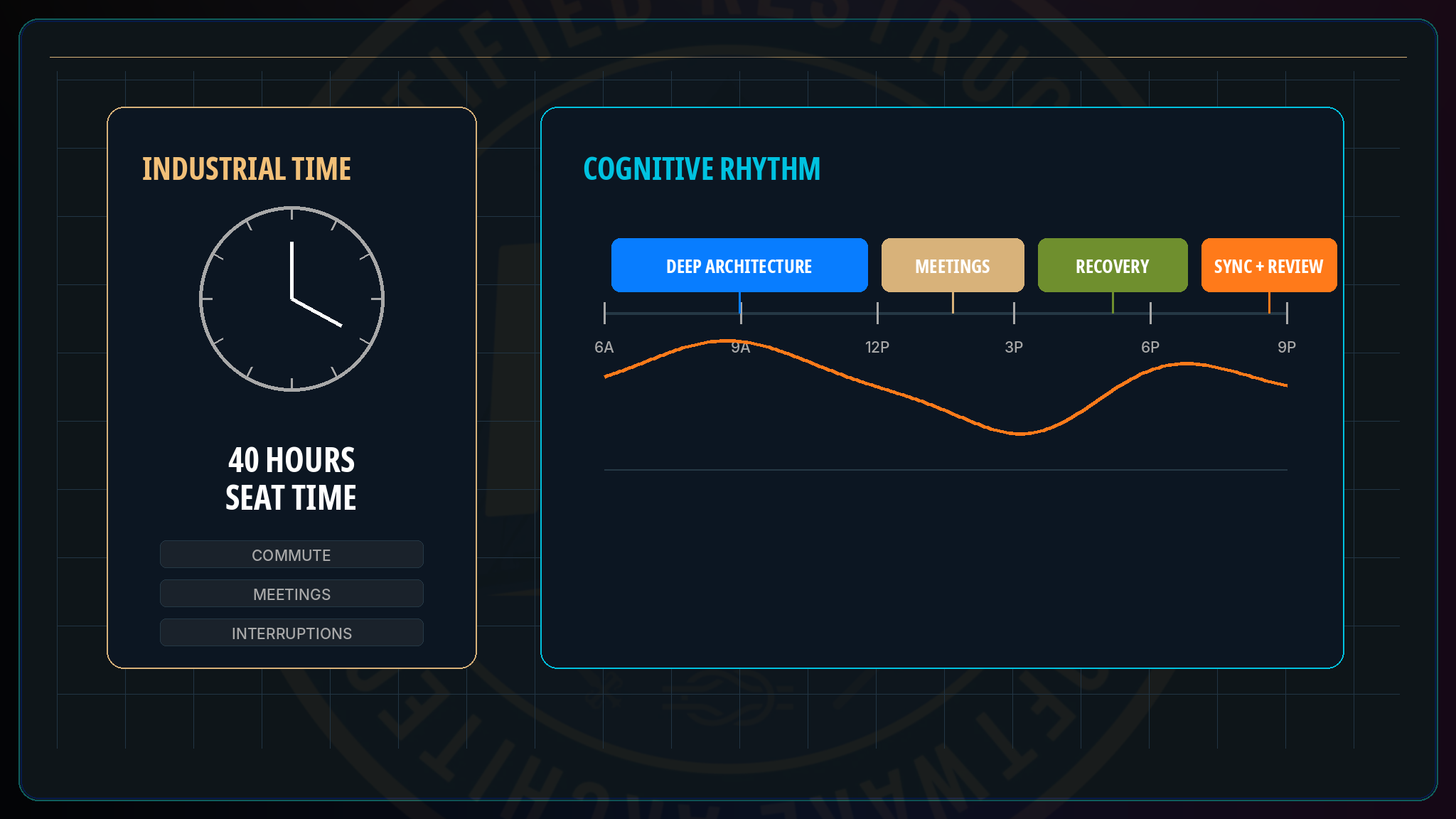
The 40-hour week made sense for industrial labor. It makes far less sense for high-performance architectural cognition. Peak engineering performance does not happen sitting in traffic at 8 AM or getting interrupted six times before lunch in an open office. The highest-value work happens in uninterrupted deep-focus windows when the brain is rested and context-rich.
Daniel Pink's book When documents that human cognitive performance follows predictable rhythms, with a measurable afternoon slump before later recovery. Traditional office systems ignore this. AI magnifies the asymmetry: one capable architect with modern AI tooling now does planning work that previously required entire teams — yet organizations still nickel-and-dime over whether somebody worked 30 or 35 hours. Even US labor policy increasingly acknowledges that full-time work does not necessarily mean forty hours. The Affordable Care Act already treats roughly thirty hours per week as full-time for healthcare purposes, while most organizations still measure knowledge work through industrial-era seat-time assumptions — wasting cognitive performance on commuting, meetings, and fragmented scheduling in the name of a forty-hour week that was never about knowledge work to begin with.
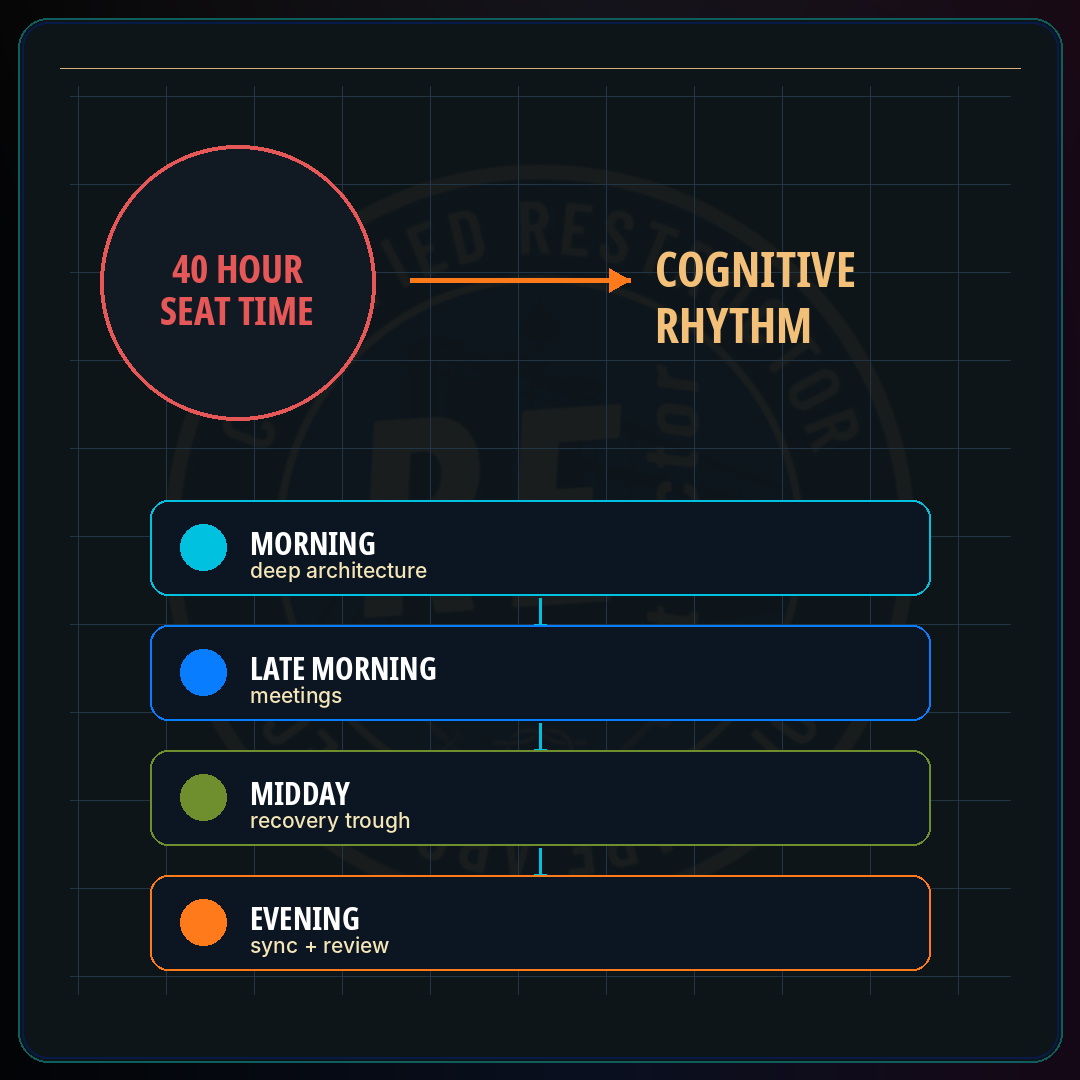
Restruct ™ proposes a shift-based cognitive model. Morning hours prioritize architecture, deep planning, AI orchestration, and systems reasoning; late morning is reserved for meetings. A midday siesta window — the word matters, because the industry pretends humans are machines — covers the natural performance trough. A shorter evening shift handles peer synchronization, review, async communication, and next-day prep. Weekends should also be seen as any other day.
And honestly, the phrase "work-life balance" sounds strange the longer you think about it. Nobody says "family-life balance" or "jiu jitsu-life balance." Those things blend into life because they matter. So why should meaningful work feel artificially separated from life?
© 2024–2026 Vitruvian Technology, Corp. All rights reserved. The Restruct Handbook and its contents are the copyrighted work of Vitruvian Technology, Corp. The handbook may be freely shared and distributed in its complete, unmodified form for educational and informational purposes, provided that all copyright and trademark notices are retained and Vitruvian Technology, Corp. (Vestive) is credited as the source. Excerpts and brief quotations may be used in articles, reviews, presentations, and other commentary with appropriate attribution. Modification, repackaging, or commercial redistribution requires prior written permission. Restruct™ and Certified Restructor™ are trademarks of Vitruvian Technology, Corp. Vestive® is a registered trademark of Vitruvian Technology, Corp. The Restruct™ methodology, the Certified Restructor™ program, and associated trademarks remain the exclusive property of Vitruvian Technology, Corp.