

Traditional Agile rituals emerged when communication tooling was primitive — ten years ago many teams were still on HipChat. Today, organizations operate inside continuous real-time communication environments. Standups, backlog grooming, and planning poker increasingly behave like operational theater compensating for organizational ambiguity rather than solving it.
Semi-daily operational chatter matters more than ritualized status meetings. Real-time collaboration, spontaneous architectural discussion, and async coordination are stronger indicators of alignment than mandatory meeting attendance. AI compresses decision timelines: product decisions now happen while AI systems are mid-execution. Organizations cannot wait three days for the next backlog refinement while Claude Code is ready to ship something in five minutes. Velocity becomes a function of trust and confidence rather than ceremony participation.
None of the above eliminates vertical coordination. Principal and Assistant Principal Architects still hold leadership meetings with senior management, peer Architecture Groups, and cross-functional partners — on whatever cadence the organization finds useful. The methodology removes ritualized horizontal status ceremony; it does not remove the standing relationships an Architecture Group has with the executive layer above it or the peer groups around it. Those cadences are organizational choices and should be set by the organization rather than prescribed by the framework.
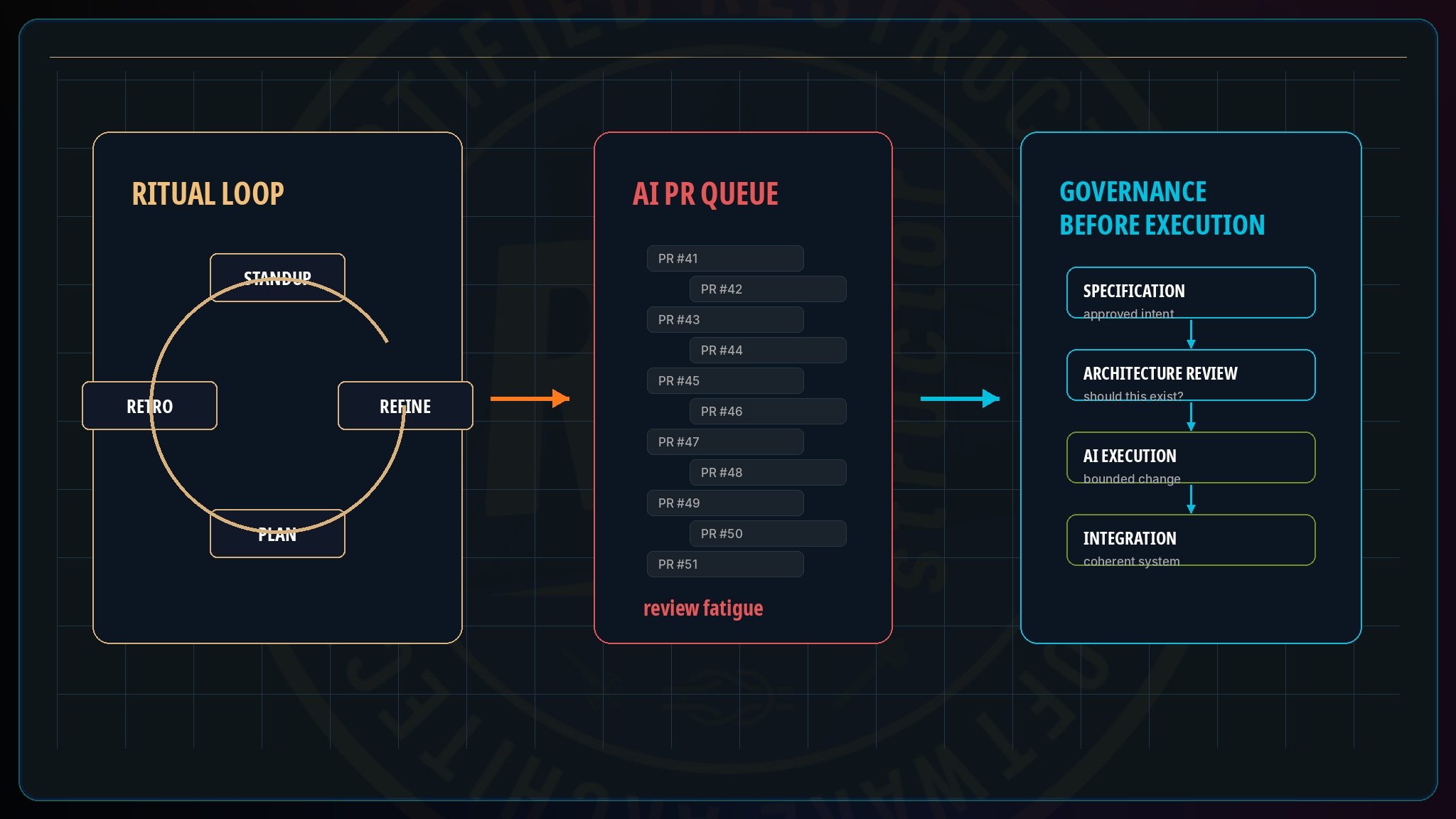
There is, however, a new ritual quietly forming inside AI-adopting organizations that deserves to be named before it ossifies the way standups did: the pull request queue. Teams that have aggressively adopted AI tooling are discovering that the bottleneck is no longer implementation. A single AI agent already operates orders of magnitude faster than a human developer for known-pattern work — a fully scaffolded multi-tenant application with authentication, role permissions, background workers, and an admin layer can now be drafted in days, not quarters. The constraint is no longer how fast code is written. The constraint is how fast humans can review and integrate it.
Most organizations have not named this yet, but they are feeling it. The morning ritual is no longer the standup; it is opening a queue of fifteen AI-assisted pull requests and trying to give each one meaningful review attention. Code review for correctness still scales reasonably — linters, tests, and type checking catch surface issues. What does not scale is review for architectural coherence across changes : noticing that PR #47 and PR #51 are quietly drifting toward incompatible mental models of the same auth contract, or that three separate AI sessions each refactored the notification layer in three different directions. That kind of review requires holding the whole system in one head, and there is no amount of reviewer headcount that makes it parallelize. Reviewing AI-generated code is also the least pleasant variety of human work — the reviewer has none of the author’s context, and review fatigue compounds across the queue.
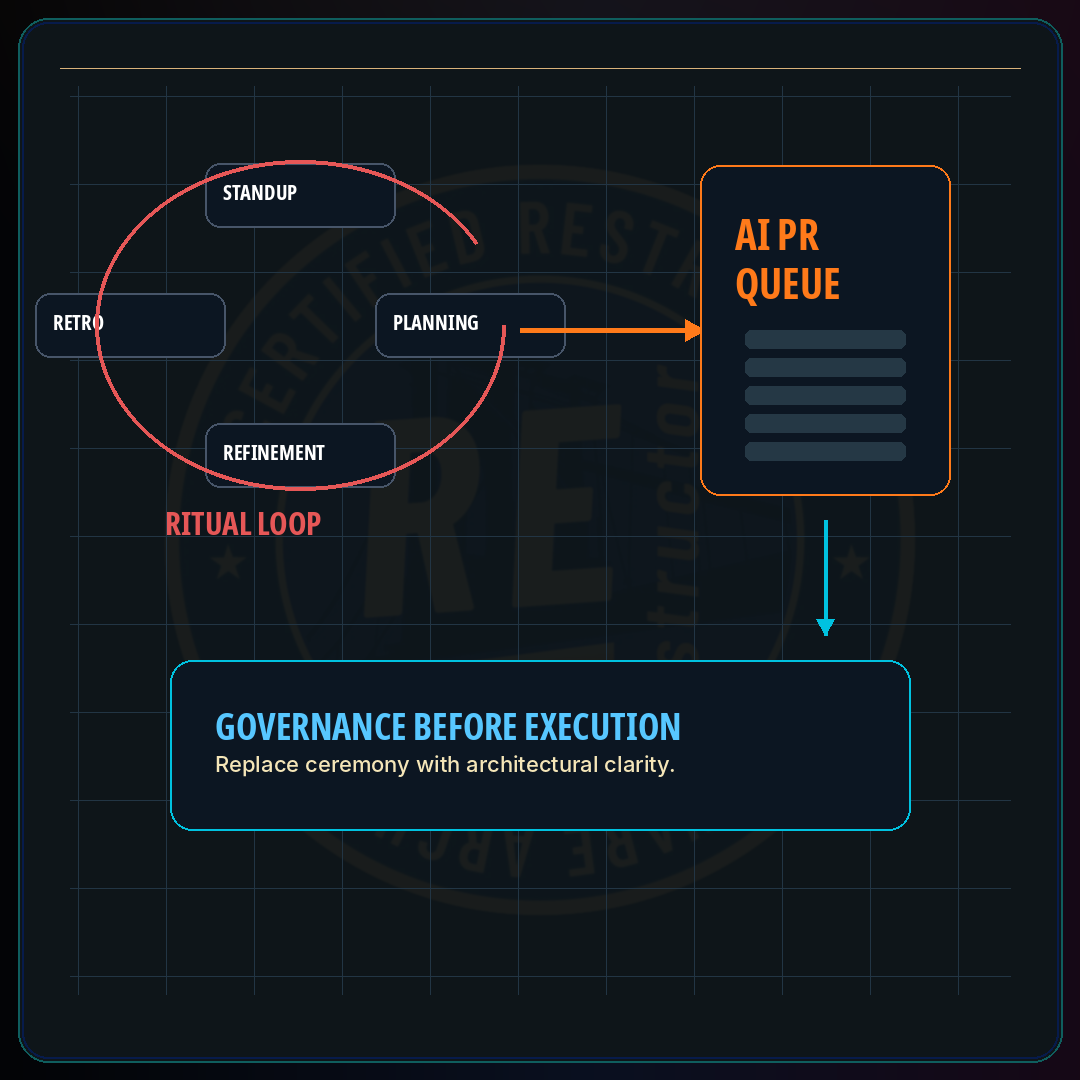
This is the new ceremony. PR queue management is becoming the standup of the AI era, except worse — it does not end at 9:15 AM, it does not produce alignment, and it actively converts the speed gain from AI execution back into elapsed time. Organizations that respond by adding more parallel AI agents are accelerating the bottleneck, not removing it: faster generation feeding the same review queue produces the same elapsed time at higher cognitive cost. The right answer is structural, and Chapter 10 develops it.
© 2024–2026 Vitruvian Technology, Corp. All rights reserved. The Restruct Handbook and its contents are the copyrighted work of Vitruvian Technology, Corp. The handbook may be freely shared and distributed in its complete, unmodified form for educational and informational purposes, provided that all copyright and trademark notices are retained and Vitruvian Technology, Corp. (Vestive) is credited as the source. Excerpts and brief quotations may be used in articles, reviews, presentations, and other commentary with appropriate attribution. Modification, repackaging, or commercial redistribution requires prior written permission. Restruct™ and Certified Restructor™ are trademarks of Vitruvian Technology, Corp. Vestive® is a registered trademark of Vitruvian Technology, Corp. The Restruct™ methodology, the Certified Restructor™ program, and associated trademarks remain the exclusive property of Vitruvian Technology, Corp.